Slide 1 of 1 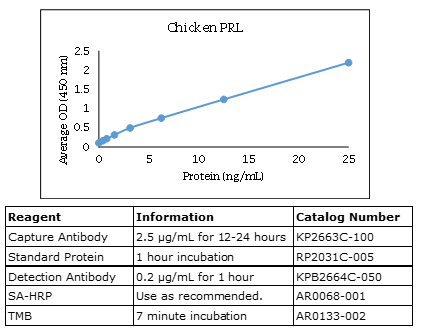
Chicken Prolactin Polyclonal Antibody
- Catalog Number:
- KP2633C
- Availability:
- In stock
- Application:
- ELISA, ELISpot, Flow Cytometry, Neutralization, Western Blot
- Host:
- Rabbit
- 100% Homology:
- Gallus gallus (chicken), Gallus lafayettii (Ceylon junglefowl)
- Label:
- Unconjugated
 Powered by Bioz
 - Anti-chicken PRL (prolactin) polyclonal antibody (catalog KP2633C) is made in rabbits, affinity-purified by chicken PRL affinity chromatography and supplied in PBS containing 0.09% NaN₃; it was raised against recombinant chicken PRL (immunogen) and the calculated molecular weight of chicken PRL is ~22.7 kDa. Store at 2-8°C (stable up to 12 months from date of receipt). Recommended working concentrations are Western blot 0.1-2 µg/mL and ELISA 1-5 µg/mL (optimize per assay); typical sandwich ELISA reagent pairings and suggested conditions are provided on the datasheet (capture antibody KP2663C; standard protein RP2031C-005; detection antibody KPB2664C-050; streptavidin-HRP AR0068-001; TMB substrate AR0133-002). In cross-reactivity testing (ELISA) this antibody shows no reactivity to human, mouse or swine PRL. It is commonly used for ELISA, ELISpot, flow cytometry, neutralization, and Western blot applications (users should validate and optimize conditions for each application). The product is made in the USA, supplied for research applications only, and is not intended for medicinal, diagnostic, or therapeutic use.
| Storage Conditions | 2°C to 8°C |
| Purification | Antigen-affinity |
| Country Of Origin | USA |
Chicken Prolactin (PRL) is a peptide hormone belonging to the prolactin/growth hormone family, which also includes growth hormone (GH) and placental lactogen–related hormones that regulate growth, metabolism, and reproductive physiology. In chickens (Gallus gallus), prolactin is produced primarily by lactotroph cells in the anterior pituitary gland and acts through the prolactin receptor (PRLR), activating intracellular signaling pathways such as JAK2/STAT5 that regulate gene expression and physiological responses. PRL plays a central role in reproductive behavior and parental care, particularly in the regulation of broodiness, where elevated prolactin levels promote nesting behavior, incubation of eggs, and suppression of further egg laying. In addition to its reproductive functions, chicken prolactin influences immune regulation, feather development, and metabolic processes, and is expressed in several tissues including the pituitary, ovary, and immune organs. Because prolactin is a key hormonal regulator of avian reproductive cycles and parental behavior, it is widely studied in poultry science to understand broodiness control, egg production, and endocrine regulation of reproduction, providing insights important for improving reproductive management and productivity in commercial poultry systems.
Citations
Please choose a size to see price
RELATED MEDIA

