Slide 1 of 1 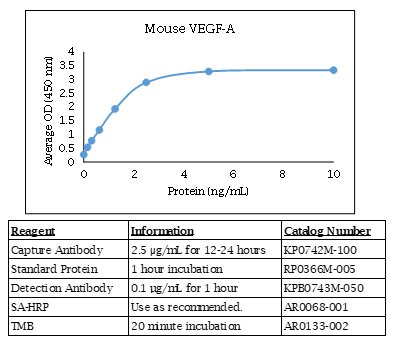
Mouse VEGF-A Polyclonal Antibody - Biotinylated
- Catalog Number:
- KPB0743M
- Availability:
- In stock
- Application:
- ELISA, ELISpot
- Host:
- Rabbit
- 100% Homology:
- Mus musculus (house mouse)
- Label:
- Biotin
 Powered by Bioz
 - The Mouse VEGF-A polyclonal antibody is labeled and has been qualified for use in ELISA. It is the detection antibody in the Kingfisher Biotech Mouse VEGF-A ELISA. The Mouse VEGF-A antibody was produced in rabbits and is antigen-affinity purified. The reactivity by species is: (Bovine VEGF-A - Strong) (Canine VEGF-A - Strong) (Caprine VEGF-A - Strong) (Chicken/Turkey VEGF-A - Weak) (Equine VEGF-A - Strong) (Feline VEGF-A - Strong) (Human/Monkey VEGF-A - Strong) (Mouse VEGF-A - Strong) (Ovine VEGF-A - Strong) (Rabbit VEGF-A - Strong) (Rat VEGF-A - Strong) (Swine VEGF-A - Strong) (Zebrafish VEGF-A - None). For research use only.
| Storage Conditions | 2°C to 8°C |
| Purification | Antigen-affinity |
| Country Of Origin | USA |
Mouse Vascular Endothelial Growth Factor A (VEGF-A) is a member of the vascular endothelial growth factor (VEGF) family, which includes VEGF-A, VEGF-B, VEGF-C, VEGF-D, and placental growth factor (PlGF)—key regulators of angiogenesis, vascular permeability, and endothelial cell growth. In mice (Mus musculus), VEGF-A is produced by a wide range of cell types including endothelial cells, macrophages, fibroblasts, epithelial cells, smooth muscle cells, and tumor cells, particularly in response to hypoxia, inflammation, and tissue injury. VEGF-A exerts its biological effects primarily through binding to VEGF receptor-1 (VEGFR-1/Flt-1) and VEGF receptor-2 (VEGFR-2/KDR) on endothelial cells, activating intracellular signaling pathways such as MAPK/ERK, PI3K/AKT, and PLCγ, which promote endothelial cell proliferation, migration, vascular permeability, and new blood vessel formation. In mice, VEGF-A plays essential roles in embryonic vascular development, organogenesis, wound healing, and tissue regeneration. Genetic studies have shown that VEGF-A deficiency results in severe defects in blood vessel formation and embryonic lethality, highlighting its critical role in vascular development. Because mice are widely used as experimental models, VEGF-A has been extensively studied in transgenic and knockout mouse models of cancer, ischemic disease, retinal disorders, and tissue regeneration, providing fundamental insights into angiogenesis, vascular biology, and therapeutic strategies targeting VEGF signaling.
Citations
50 ug
Price: $400.00
RELATED MEDIA

