Slide 1 of 1 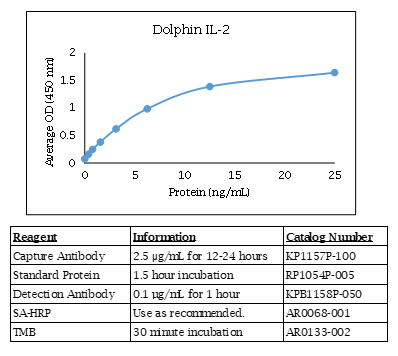
Dolphin IL-2 Polyclonal Antibody - Biotinylated
- Catalog Number:
- KPB1158P
- Availability:
- In stock
- Application:
- ELISA, ELISpot
- Host:
- Rabbit
- 100% Homology:
- Globicephala melas (long-finned pilot whale), Orcinus orca (killer whale), Phocoena sinus (vaquita), Tursiops truncatus (common bottlenose dolphin)
- Label:
- Biotin
 Powered by Bioz
 - The Dolphin IL-2 polyclonal antibody is labeled and has been qualified for use in ELISA. It is the detection antibody in the Kingfisher Biotech Dolphin IL-2 ELISA. The Dolphin IL-2 antibody was produced in rabbits and is antigen-affinity purified. The reactivity by species is: (Bovine IL-2 - None) (Canine IL-2 - None) (Chicken IL-2 - None) (Cynomolgus Monkey IL-2 - None) (Dolphin IL-2 - Strong) (Equine IL-2 - None) (Feline IL-2 - None) (Ferret IL-2 - None) (Human IL-2 - None) (Mouse IL-2 - None) (Ovine IL-2 - None) (Rabbit IL-2 - None) (Swine IL-2 - None). For research use only.
| Storage Conditions | 2°C to 8°C |
| Purification | Antigen-affinity |
| Country Of Origin | USA |
Dolphin IL-2 (Interleukin-2) is a key T cell–derived cytokine that regulates lymphocyte proliferation, differentiation, and immune homeostasis in dolphins (e.g., Tursiops truncatus). IL-2 is produced primarily by activated CD4⁺ and CD8⁺ T lymphocytes following antigen recognition and costimulatory signaling, and it functions through the IL-2 receptor complex (IL-2Rα/CD25, IL-2Rβ, and the common γ chain) to promote clonal expansion of antigen-specific T cells, enhance cytotoxic T lymphocyte and natural killer (NK) cell activity, and support development and maintenance of regulatory T cells (Tregs). In healthy dolphins, basal IL-2 expression is expected to be low but increases during infection, inflammatory stimulation, or environmental stress exposure. Altered IL-2 responses may occur during viral or bacterial infections, chronic inflammatory conditions, or immune challenges observed in both managed and free-ranging populations. Dolphins serve as valuable comparative models for studying marine mammal immunology, environmental immunotoxicology, and host responses to emerging infectious diseases. In marine mammal and translational research, dolphin IL-2 is used as a biomarker of T cell activation and cell-mediated immunity, providing insight into adaptive immune function and immune system health in marine species.
Citations
50 ug
Price: $400.00
RELATED MEDIA

