Slide 1 of 1 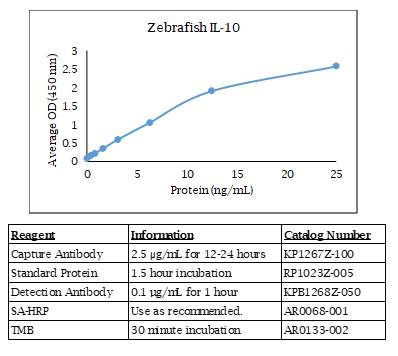
Zebrafish IL-10 Polyclonal Antibody - Biotinylated
- Catalog Number:
- KPB1268Z
- Availability:
- In stock
- Application:
- ELISA, ELISpot
- Host:
- Rabbit
- 100% Homology:
- Danio rerio (zebrafish)
- Label:
- Biotin
 Powered by Bioz
 - The Zebrafish IL-10 polyclonal antibody is labeled and has been qualified for use in ELISA. It is the detection antibody in the Kingfisher Biotech Zebrafish IL-10 ELISA. The Zebrafish IL-10 antibody was produced in rabbits and is antigen-affinity purified. The reactivity by species is: (Bovine IL-10 - None) (Chicken IL-10 - None) (Dolphin IL-10 - None) (Equine IL-10 - None) (Mouse IL-10 - None) (Ovine IL-10 - None) (Swine IL-10 - None) (Zebrafish IL-10 - Strong). For research use only.
| Storage Conditions | 2°C to 8°C |
| Purification | Antigen-affinity |
| Country Of Origin | USA |
Zebrafish (Danio rerio) Interleukin-10 (IL-10) is a conserved anti-inflammatory cytokine produced by macrophages, regulatory T cell–like populations, and other immune cells, where it plays a central role in controlling excessive inflammation and maintaining immune homeostasis in teleost fish. IL-10 signals through the IL-10 receptor complex (il10ra/il10rb), activating JAK/STAT3 pathways that suppress pro-inflammatory cytokine production (including il1b, tnfa, and il6), limit macrophage activation, and promote resolution of inflammation. In zebrafish, IL-10 is induced during bacterial infections such as Mycobacterium marinum and Streptococcus spp., viral challenges, tissue injury, and models of intestinal inflammation, where it helps balance pathogen clearance with prevention of immune-mediated tissue damage. IL-10–deficient zebrafish exhibit heightened inflammatory responses and increased susceptibility to inflammatory pathology, highlighting its essential regulatory role. Because zebrafish are widely used for live imaging of immune cell behavior, genetic manipulation, and high-throughput drug screening, characterization of IL-10 supports studies of cytokine network regulation, macrophage polarization, mucosal immunity, and chronic inflammatory disease mechanisms. As a functional regulator of immune tolerance and inflammatory resolution, zebrafish IL-10 provides valuable comparative insight into conserved vertebrate anti-inflammatory pathways relevant to human inflammatory and autoimmune diseases.
Citations
50 ug
Price: $400.00
RELATED MEDIA
