Slide 1 of 1 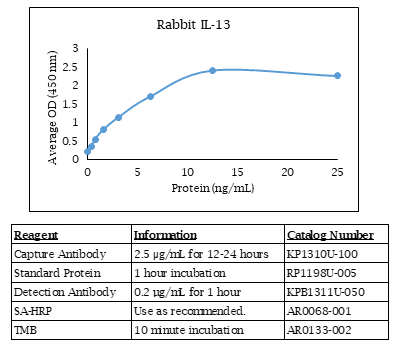
Rabbit IL-13 Polyclonal Antibody - Biotinylated
- Catalog Number:
- KPB1311U
- Availability:
- In stock
- Application:
- ELISA, ELISpot
- Host:
- Chicken
- 100% Homology:
- Oryctolagus cuniculus (rabbit)
- Label:
- Biotin
 Powered by Bioz
 - The Rabbit IL-13 polyclonal antibody is labeled and has been qualified for use in ELISA. It is the detection antibody in the Kingfisher Biotech Rabbit IL-13 ELISA. The Rabbit IL-13 antibody was produced in chickens and is antigen-affinity purified. The reactivity by species is: (Bovine IL-13 - Weak) (Canine IL-13 - Weak) (Caprine IL-13 - Weak) (Chicken IL-13 - None) (Dolphin IL-13 - Weak) (Equine IL-13 - None) (Mouse IL-13 - None) (Ovine IL-13 - Weak) (Rabbit IL-13 - Strong) (Swine IL-13 - Weak) (Zebrafish IL-13 - None). For research use only.
| Storage Conditions | 2°C to 8°C |
| Purification | Antigen-affinity |
| Country Of Origin | USA |
Rabbit Interleukin-13 (IL-13) is a Th2-associated cytokine produced primarily by activated CD4⁺ T helper 2 (Th2) cells and other type 2 immune populations in rabbits (Oryctolagus cuniculus), where it plays a central role in regulating allergic inflammation, mucosal immunity, and tissue remodeling. IL-13 signals through receptor complexes composed of IL-13Rα1 and IL-4Rα, activating JAK/STAT6 pathways that promote alternative (M2) macrophage activation, IgE-associated responses, mucus production, and modulation of pro-inflammatory cytokine signaling. In rabbit health, IL-13 is particularly relevant in parasitic infections, allergic skin disease, and respiratory inflammation, where Th2 polarization contributes to eosinophilic infiltration and tissue repair but may also promote chronic inflammation or fibrosis if dysregulated. Rabbits are widely used as models for asthma, pulmonary inflammation, atherosclerosis, and ocular inflammatory disease, and IL-13 plays a key role in experimental airway hyperresponsiveness and mucus hypersecretion models. As both a biomarker and functional mediator of type 2 immune responses, rabbit IL-13 supports studies of Th1/Th2 immune balance, cytokine-driven tissue remodeling, and development of targeted anti-cytokine therapies relevant to human allergic and fibrotic diseases.
Citations
50 ug
Price: $400.00
RELATED MEDIA
