Slide 1 of 1 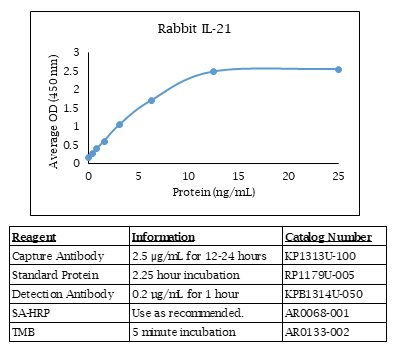
Rabbit IL-21 Polyclonal Antibody - Biotinylated
- Catalog Number:
- KPB1314U
- Availability:
- In stock
- Application:
- ELISA, ELISpot
- Host:
- Chicken
- 100% Homology:
- Oryctolagus cuniculus (rabbit)
- Label:
- Biotin
 Powered by Bioz
 - The Rabbit IL-21 polyclonal antibody is labeled and has been qualified for use in ELISA. It is the detection antibody in the Kingfisher Biotech Rabbit IL-21 ELISA. The Rabbit IL-21 antibody was produced in chickens and is antigen-affinity purified. The reactivity by species is: (Atlantic Salmon IL-21 - None) (Bovine IL-21 - None) (Canine IL-21 - None) (Chicken IL-21 - None) (Rabbit IL-21 - Strong) (Ovine 21 - Weak) (Swine IL-21 - None). For research use only.
| Storage Conditions | 2°C to 8°C |
| Purification | Antigen-affinity |
| Country Of Origin | USA |
Rabbit IL-21 (Interleukin-21) is a cytokine of the common γ chain (γc) family that plays a central role in regulating adaptive immune responses in rabbits (Oryctolagus cuniculus). IL-21 is produced primarily by activated CD4⁺ T cells, particularly T follicular helper (Tfh) cells and Th17 cells, following antigen stimulation. It signals through the IL-21 receptor (IL-21R) in association with the common γ chain, activating downstream JAK/STAT pathways—predominantly STAT3—to regulate gene expression in B cells, T cells, and natural killer (NK) cells. IL-21 promotes B cell proliferation, plasma cell differentiation, immunoglobulin class switching, and antibody production, while enhancing CD8⁺ T cell cytotoxic function and NK cell activity. In healthy rabbits, basal IL-21 expression is generally low but increases during infection, vaccination, and immune activation. Rabbit IL-21 is particularly relevant in studies of vaccine immunogenicity, tuberculosis models, atherosclerosis research, ocular inflammation, and tumor immunology, where robust T cell–dependent antibody and cytotoxic responses are important. In biomedical research, rabbit IL-21 serves as a biomarker of T cell–dependent B cell help and humoral immunity and supports investigation of adaptive immune regulation and immunotherapeutic strategies.
Citations
50 ug
Price: $400.00
RELATED MEDIA
