Slide 1 of 1 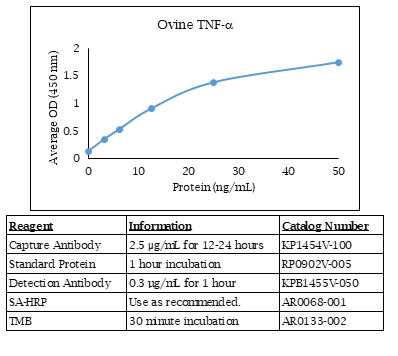
Ovine TNF alpha Polyclonal Antibody - Biotinylated
- Catalog Number:
- KPB1455V
- Availability:
- In stock
- Application:
- ELISA, ELISpot
- Host:
- Rabbit
- 100% Homology:
- Ovis aries (sheep), Ovis canadensis (bighorn sheep)
- Label:
- Biotin
- The Ovine TNF alpha polyclonal antibody is labeled and has been qualified for use in ELISA. It is the detection antibody in the Kingfisher Ovine TNF alpha ELISA. The Ovine TNF alpha antibody was produced in rabbits and is antigen-affinity purified. The reactivity by species is: (Atlantic Salmon TNF-alpha - None) (Bovine TNF-alpha - None) (Canine TNF-alpha - None) (Caprine TNF-alpha - Strong) (Cynomolgus Monkey TNF-alpha - None) (Dolphin TNF-alpha - None) (Equine TNF-alpha - None) (Feline TNF-alpha - None) (Guinea Pig TNF-alpha - None) (Human TNF-alpha - None) (Mouse TNF-alpha - None) (Ovine TNF-alpha - Strong) (Rabbit TNF-alpha - None) (Swine TNF-alpha - None) (Zebrafish TNF-alpha - None). For research use only.
| Storage Conditions | 2°C to 8°C |
| Purification | Antigen-affinity |
| Country Of Origin | USA |
- Ovine Tumor Necrosis Factor Alpha (TNF-α) (also known as TNF or cachectin) is a proinflammatory cytokine that plays a central role in innate immune responses, inflammation, and host defense against pathogens in sheep (Ovis aries). TNF-α is a member of the tumor necrosis factor (TNF) superfamily, which includes related cytokines such as TNF-β (lymphotoxin-α), Fas ligand (FasL), CD40 ligand (CD40L), and TRAIL, proteins that regulate immune signaling, apoptosis, and inflammatory pathways. In sheep, TNF-α is primarily produced by activated macrophages, monocytes, dendritic cells, and T lymphocytes in response to infection, endotoxin exposure, or tissue injury. TNF-α exerts its biological effects by binding to TNF receptors TNFR1 (p55) and TNFR2 (p75), activating intracellular signaling pathways including NF-κB, MAPK, and caspase-mediated pathways, which regulate cytokine production, immune cell activation, apoptosis, and inflammatory responses. In ovine health, TNF-α contributes to immune responses against bacterial, viral, and parasitic infections, including diseases such as ovine mastitis, respiratory infections, and parasitic infestations, where it promotes macrophage activation and inflammatory defense mechanisms. While TNF-α is essential for pathogen clearance, excessive or prolonged TNF signaling can contribute to chronic inflammation and tissue damage. Because TNF-α is a key mediator of inflammatory responses, ovine TNF-α is studied in veterinary immunology, infectious disease research, and inflammatory disease models, contributing to improved understanding of immune regulation and disease resistance in sheep.
50 ug
Price: $400.00

CITATIONS
Takahashi Y, Takahashi T, Usuda H, Carter S, Fee EL, Furfaro L, Chemtob S, Olson DM, Keelan JA, Kallapur S, Kemp MW. Pharmacological blockade of the interleukin-1 receptor suppressed Escherichia coli lipopolysaccharide-induced neuroinflammation in preterm fetal sheep. Am J Obstet Gynecol MFM. 2023 Nov;5(11):101124. doi: 10.1016/j.ajogmf.2023.101124. Epub 2023 Aug 18. PMID: 37597799.
Application: ELISA
Sample Type: Amniotic Fliuid, Fetal Lung Tissue
Peiris RM, May CN, Booth LC, McAllen RM, McKinley MJ, Hood S, Martelli D, Bellomo R, Lankadeva YR. Splanchnic sympathetic nerve denervation improves bacterial clearance and clinical recovery in established ovine Gram-negative bacteremia. Intensive Care Med Exp. 2023 Aug 3;11(1):53. doi: 10.1186/s40635-023-00530-6. PMID: 37535121; PMCID: PMC10400745.
Application: ELISA
Sample Type: Plasma