Slide 1 of 1 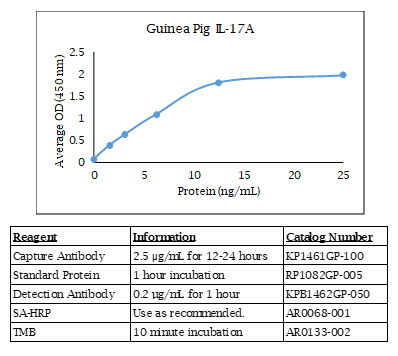
Guinea Pig IL-17A Polyclonal Antibody - Biotinylated
- Catalog Number:
- KPB1462GP
- Availability:
- In stock
- Application:
- ELISA, ELISpot
- Host:
- Rabbit
- 100% Homology:
- Cavia porcellus (domestic guinea pig)
- Label:
- Biotin
 Powered by Bioz
 - The Guinea Pig IL-17A polyclonal antibody is labeled and has been qualified for use in ELISA. It is the detection antibody in the Kingfisher Guinea Pig IL-17A ELISA. The Guinea Pig IL-17A antibody was produced in rabbits and is antigen-affinity purified. The reactivity by species is: (Bovine IL-17A - None) (Canine IL-17A - None) (Caprine IL-17A - None) (Cynomolgus Monkey IL-17A - None) (Dolphin IL-17A - None) (Equine IL-17A - None) (Feline IL-17A - None) (Ferret IL-17A - None) (Guinea Pig IL-17A - Strong) (Human IL-17A - None) (Mouse IL-17A - None) (Ovine IL-17A - None) (Rabbit IL-17A - None) (Rat IL-17A - None) (Swine IL-17A - None) (Zebrafish IL-17a/f1 - None). For research use only.
| Storage Conditions | 2°C to 8°C |
| Purification | Antigen-affinity |
| Country Of Origin | USA |
Guinea pig IL-17A (Interleukin-17A) is a pro-inflammatory cytokine belonging to the IL-17 family that plays an important role in host defense and inflammatory responses in guinea pigs (Cavia porcellus). IL-17A is produced primarily by Th17 cells, as well as by γδ T cells and other innate lymphoid populations, in response to microbial infection and immune stimulation. It acts on epithelial, endothelial, and stromal cells to induce the expression of pro-inflammatory cytokines, chemokines (such as CXCL8), and antimicrobial peptides, thereby promoting neutrophil recruitment and enhancing mucosal and barrier immunity, particularly in the respiratory tract. In healthy guinea pigs, basal IL-17A expression is typically low, but levels increase during bacterial infection, allergic airway inflammation, and experimental immune challenge. In biomedical research, guinea pig IL-17A is especially relevant in models of tuberculosis (Mycobacterium tuberculosis), asthma, and allergic airway disease, where Th17-mediated responses contribute to neutrophilic inflammation and granuloma formation. Characterization of IL-17A in guinea pigs provides valuable insight into mucosal immunity, host–pathogen interactions, and inflammatory mechanisms in translational respiratory and infectious disease research.
Citations
50 ug
Price: $400.00
RELATED MEDIA
