Slide 1 of 1 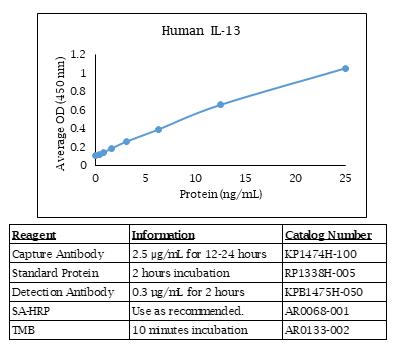
Human IL-13 Polyclonal Antibody - Biotinylated
- Catalog Number:
- KPB1475H
- Availability:
- In stock
- Application:
- ELISA, ELISpot
- Host:
- Rabbit
- 100% Homology:
- Homo sapiens (human)
- Label:
- Biotin
 Powered by Bioz
 - The Human IL-13 polyclonal antibody is labeled and has been qualified for use in ELISA. It is the detection antibody in the Kingfisher Human IL-13 ELISA. The Human IL-13 antibody was produced in rabbits and is antigen-affinity purified. The reactivity by species is: (Bovine IL-13 - None) (Canine IL-13 - None) (Caprine IL-13 - None) (Chicken IL-13 - None) (Dolphin IL-13 - Weak) (Equine IL-13 - None) (Human IL-13 - Strong) (Mouse IL-13 - None) (Ovine IL-13 - None) (Rabbit IL-13 - None) (Swine IL-13 - None) (Zebrafish IL-13 - None). For research use only.
| Storage Conditions | 2°C to 8°C |
| Purification | Antigen-affinity |
| Country Of Origin | USA |
Human Interleukin-13 (IL-13) is a Th2-associated cytokine produced primarily by activated CD4⁺ T helper 2 (Th2) cells, group 2 innate lymphoid cells (ILC2s), mast cells, and basophils, where it plays a central role in allergic inflammation, mucosal immunity, and tissue remodeling. IL-13 signals through receptor complexes composed of IL-13Rα1 and IL-4Rα, activating JAK/STAT6 pathways that regulate gene expression involved in IgE class switching, alternative (M2) macrophage activation, mucus production, epithelial barrier function, and suppression of certain pro-inflammatory cytokines. IL-13 is critically implicated in allergic diseases such as asthma, atopic dermatitis, chronic rhinosinusitis with nasal polyps, and eosinophilic esophagitis, where elevated IL-13 drives airway hyperresponsiveness, goblet cell hyperplasia, fibrosis, and tissue remodeling. Dysregulated IL-13 signaling also contributes to fibrotic diseases affecting the lung, liver, and other organs. As a key mediator of type 2 immunity, IL-13 has become a major therapeutic target, with monoclonal antibodies directed against IL-13 or the IL-4Rα receptor subunit demonstrating clinical benefit in allergic and inflammatory conditions. Consequently, human IL-13 is central to research on Th2-mediated inflammation, barrier immunity, fibrosis biology, and development of targeted cytokine-modulating therapies.
Citations
50 ug
Price: $400.00
RELATED MEDIA
