Slide 1 of 1 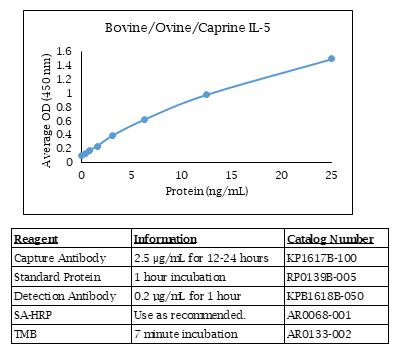
Multi-species (Bovine, Caprine, Ovine) IL-5 Polyclonal Antibody - Biotinylated
- Catalog Number:
- KPB1618B
- Availability:
- In stock
- Application:
- ELISA, ELISpot
- Host:
- Rabbit
- 100% Homology:
- Bison bison bison (American buffalo), Bos gaurus (gaur), Bos indicus (zebu), Bos taurus (cattle), Capra hircus (goat), Ovis aries (sheep)
- Label:
- Biotin
 Powered by Bioz
 - The Bovine/Caprine/Ovine IL-5 polyclonal antibody is labeled and has been qualified for use in ELISA. It is the detection antibody in the Kingfisher Bovine/Caprine/Ovine IL-5 ELISA. The Bovine/Caprine/Ovine IL-5 antibody was produced in rabbits and is antigen-affinity purified. The reactivity by species is: (Bovine IL-5 - Strong) (Canine IL-5 - None) (Equine IL-5 - None) (Feline IL-5 - None) (Rabbit IL-5 - None). For research use only.
| Storage Conditions | 2°C to 8°C |
| Purification | Antigen-affinity |
| Country Of Origin | USA |
Bovine (Bos taurus), Caprine (Capra hircus), and Ovine (Ovis aries) Interleukin-5 (IL-5) is a Th2-associated cytokine produced primarily by activated CD4⁺ T helper 2 (Th2) cells, mast cells, and type 2 innate lymphoid cells in ruminants, where it plays a central role in eosinophil differentiation, activation, recruitment, and survival. IL-5 is a member of the common beta chain (βc) cytokine family, which also includes IL-3 and granulocyte–macrophage colony-stimulating factor (GM-CSF); these cytokines share the βc receptor subunit and regulate hematopoiesis and myeloid cell function. IL-5 signals through a receptor complex composed of IL-5Rα and the shared βc chain, activating JAK/STAT and MAPK pathways that promote eosinophil maturation in the bone marrow and enhance effector responses in peripheral tissues. In cattle, goats, and sheep, IL-5 is particularly important in immune responses to gastrointestinal nematodes and lungworms, where Th2 polarization and eosinophil activation contribute to parasite control and mucosal repair. Elevated IL-5 expression is also associated with allergic-type inflammation and certain respiratory or parasitic conditions, and excessive or prolonged IL-5 signaling may contribute to tissue pathology or fibrosis. As a biomarker of type 2 immune activation, IL-5 is relevant in vaccine development, host–parasite interaction studies, and breeding programs aimed at enhancing parasite resistance in ruminant production systems. Characterization of IL-5 in these species supports veterinary research into Th2 immunity, eosinophil biology, and development of immunomodulatory strategies to improve health, productivity, and disease resilience in livestock.
Citations
50 ug
Price: $400.00
RELATED MEDIA
