Slide 1 of 1 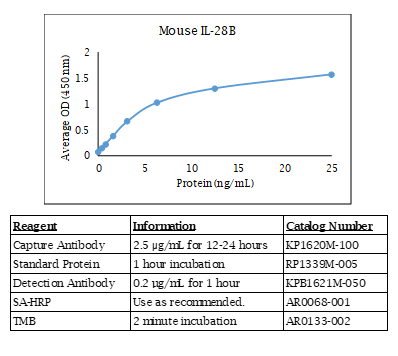
Mouse IFN Lambda (IL-28B) Polyclonal Antibody - Biotinylated
- Catalog Number:
- KPB1621M
- Availability:
- In stock
- Application:
- ELISA, ELISpot
- Host:
- Rabbit
- 100% Homology:
- Mus musculus (house mouse)
- Label:
- Biotin
 Powered by Bioz
 - The Mouse IL-28B polyclonal antibody is labeled and has been qualified for use in ELISA. It is the detection antibody in the Kingfisher Mouse IL-28B ELISA. The Mouse IL-28B antibody was produced in rabbits and is antigen-affinity purified. The reactivity by species is: (Equine IL-28B - None) (Swine IL-28B - None) (Mouse IL-28B - Strong). For research use only.
| Storage Conditions | 2°C to 8°C |
| Purification | Antigen-affinity |
| Country Of Origin | USA |
Mouse interferon lambda 3 (IFN-λ3), also known as interleukin-28B (IL-28B), is a member of the type III interferon family and functions as a critical antiviral cytokine that signals through the IFNLR1 (IL-28Rα)/IL-10R2 receptor complex, activating JAK/STAT pathways and inducing interferon-stimulated genes (ISGs) that suppress viral replication primarily at epithelial barriers. In mice, IFN-λ3 plays a central role in mucosal antiviral immunity within the respiratory and gastrointestinal tracts, contributing to host defense against pathogens such as influenza virus, respiratory syncytial virus, norovirus, rotavirus, and SARS-like coronaviruses in experimental models. Unlike type I interferons, type III interferons act predominantly on epithelial cells and produce localized antiviral responses with limited systemic inflammation, making murine IFN-λ3 essential for studying barrier-specific immunity, viral transmission dynamics, and immune-mediated tissue protection. As mice are foundational models for immunology and infectious disease research, murine IFN-λ3 (IL-28B) is widely used in mechanistic studies of interferon signaling, antiviral therapeutics, and vaccine development relevant to human respiratory and enteric viral infections.
Citations
50 ug
Price: $400.00
RELATED MEDIA
