Slide 1 of 1 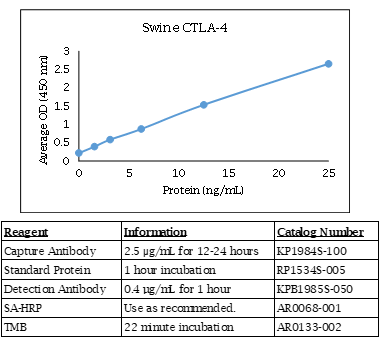
Swine CTLA-4 Polyclonal Antibody - Biotinylated
- Catalog Number:
- KPB1985S
- Availability:
- In stock
- Application:
- ELISA, ELISpot
- Host:
- Rabbit
- 100% Homology:
- Sus scrofa (pig)
- Label:
- Biotin
 Powered by Bioz
 - The Swine CTLA-4 polyclonal antibody is labeled and has been qualified for use in ELISA. It is the detection antibody in the Kingfisher Swine CTLA-4 ELISA. The Swine CTLA-4 antibody was produced in rabbits and is antigen-affinity purified. The reactivity by species is: (Swine CTLA-4 - Strong) (Bovine CTLA-4 - None) (Cynomolgus monkey CTLA-4 - None) (Human CTLA-4 - None) (Rabbit CTLA-4 - None). For research use only.
- Recombinant Swine CTLA-4 - Strong Recombinant bovine CTLA-4 - None Recombinant cynomolgus monkey CTLA-4 - None Recombinant human CTLA-4 - None Recombinant rabbit CTLA-4 - None
| Storage Conditions | 2°C to 8°C |
| Purification | Antigen-affinity |
| Country Of Origin | USA |
Swine CTLA-4 (Cytotoxic T-Lymphocyte–Associated Protein 4, also known as CD152) is an immune checkpoint receptor belonging to the immunoglobulin superfamily that functions as a key negative regulator of T-cell activation in pigs (Sus scrofa). CTLA-4 is primarily expressed on activated CD4⁺ and CD8⁺ T lymphocytes and on regulatory T cells (Tregs) following antigen stimulation. It binds to the costimulatory ligands CD80 (B7-1) and CD86 (B7-2) on antigen-presenting cells such as dendritic cells, macrophages, and B cells, competing with the activating receptor CD28 for these ligands. Engagement of CTLA-4 transmits inhibitory signals that suppress T-cell proliferation, cytokine production, and immune activation, thereby helping maintain immune homeostasis and peripheral tolerance. In swine, CTLA-4 signaling is particularly relevant during viral infections such as porcine reproductive and respiratory syndrome virus (PRRSV), where excessive or dysregulated T-cell responses can influence disease outcome. Pigs are also used as large-animal models for transplantation immunology, and CTLA-4–Ig fusion proteins (similar to the human therapeutic abatacept/belatacept) have been tested in pig-to-nonhuman primate xenotransplantation studies, where blockade of CD28-mediated costimulation through the CTLA-4 pathway helps reduce T-cell–mediated graft rejection. These studies make swine CTLA-4 an important component of translational research on immune checkpoint regulation and tolerance induction in transplantation and immunotherapy.
Citations
50 ug
Price: $400.00
RELATED MEDIA

