Slide 1 of 1 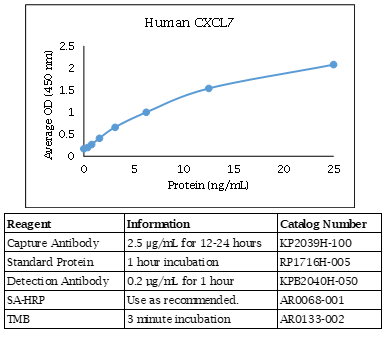
Human CXCL7 Polyclonal Antibody - Biotinylated
- Catalog Number:
- KPB2040H
- Availability:
- In stock
- Application:
- ELISA, ELISpot
- Host:
- Rabbit
- 100% Homology:
- Homo sapiens (human), Pan paniscus (pygmy chimpanzee), Pan troglodytes (chimpanzee)
- Label:
- Biotin
 Powered by Bioz
 - The Human CXCL7 polyclonal antibody is labeled and has been qualified for use in ELISA. It is the detection antibody in the Kingfisher Human CXCL7 ELISA. The Human CXCL7 antibody was produced in rabbits and is antigen-affinity purified. The reactivity by species is: (Human CXCL7 - Strong) (Canine CXCL7 - None) (Cynomolgus monkey CXCL7 - Strong) (Equine CXCL7 - None) (Mouse CXCL7 - None) (Swine CXCL7 - None). For research use only.
- Recombinant human CXCL7 - Strong Recombinant canine CXCL7 - None Recombinant cynomolgus monkey CXCL7 - Strong Recombinant equine CXCL7 - None Recombinant mouse CXCL7 - None Recombinant swine CXCL7 - None
| Storage Conditions | 2°C to 8°C |
| Purification | Antigen-affinity |
| Country Of Origin | USA |
Human CXCL7 (C-X-C motif chemokine ligand 7), also known as NAP-2 (neutrophil-activating peptide 2) or PPBP (pro-platelet basic protein), is a platelet-derived chemokine belonging to the ELR⁺ CXC chemokine family, which includes CXCL1, CXCL2, CXCL3, and CXCL5 that regulate neutrophil recruitment during inflammatory responses. In humans (Homo sapiens), CXCL7 is produced primarily by platelets and megakaryocytes and is released during platelet activation following vascular injury, infection, or inflammatory signaling. CXCL7 signals mainly through the chemokine receptor CXCR2, which is expressed on neutrophils and other innate immune cells, promoting chemotaxis, activation, and migration of neutrophils to sites of tissue damage or infection. In human physiology, CXCL7 contributes to the coordination between hemostasis and immune responses, influencing platelet–leukocyte interactions, vascular inflammation, and tissue repair. Dysregulated CXCL7 activity has been associated with cardiovascular disease, thrombosis, inflammatory disorders, and cancer, where platelet-derived chemokines can affect angiogenesis, leukocyte recruitment, and tumor microenvironment signaling. As a result, human CXCL7 is widely studied in cardiovascular research, thrombosis biology, inflammation studies, and cancer immunology as a mediator of platelet-driven inflammatory and immune processes.
Citations
50 ug
Price: $400.00
RELATED MEDIA

