Slide 1 of 1 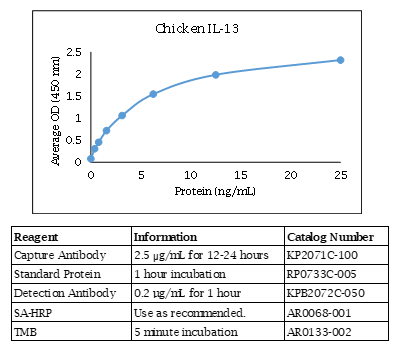
Chicken IL-13 Polyclonal Antibody - Biotinylated
- Catalog Number:
- KPB2072C
- Availability:
- In stock
- Application:
- ELISA, ELISpot
- Host:
- Rabbit
- 100% Homology:
- Gallus gallus (chicken)
- Label:
- Biotin
 Powered by Bioz
 - The Chicken IL-13 polyclonal antibody is labeled and has been qualified for use in ELISA. It is the detection antibody in the Kingfisher Biotech Chicken IL-13 ELISA. The Chicken IL-13 antibody was produced in rabbits and is antigen-affinity purified. The reactivity by species is: (Chicken IL-13 - Strong) (Bovine IL-13 - None) (Canine IL-13 - None) (Caprine IL-13 - None) (Dolphin IL-13 - None) (Equine IL-13 - None) (Feline IL-13 - None) (Human IL-13 - None) (Mouse IL-13 - None) (Ovine IL-13 - None) (Rabbit IL-13 - None) (Swine IL-13 - None) (Zebrafish IL-13 - None). For research use only.
- Recombinant chicken IL-13 - Strong Recombinant bovine IL-13 - None Recombinant canine IL-13 - None Recombinant caprine IL-13 - None Recombinant dolphin IL-13 - None Recombinant equine IL-13 - None Recombinant feline IL-13 - None Recombinant human IL-13 - None Recombinant mouse IL-13 - None Recombina
| Storage Conditions | 2°C to 8°C |
| Purification | Antigen-affinity |
| Country Of Origin | USA |
Chicken Interleukin-13 (IL-13) is a Th2-associated cytokine produced primarily by CD4⁺ T helper–like cells and other type 2 immune populations in chickens (Gallus gallus), where it plays an important role in regulating mucosal immunity, alternative macrophage activation, and modulation of inflammatory responses. IL-13 signals through receptor components homologous to IL-4Rα and IL-13Rα chains, activating JAK/STAT6-dependent pathways that influence gene expression involved in mucus production, antibody-associated responses, and suppression of excessive pro-inflammatory cytokine signaling. In poultry health, IL-13 is particularly relevant in immune responses to parasitic infections such as Eimeria spp. (coccidiosis) and helminths, where Th2 polarization contributes to parasite control and intestinal tissue repair. IL-13 may also influence immune regulation during viral infections such as avian influenza virus and Newcastle disease virus by shaping the balance between Th1 and Th2 responses. Dysregulated IL-13 expression can contribute to chronic inflammation, impaired pathogen clearance, or altered growth performance. As a biomarker of type 2 immune activation, chicken IL-13 is important in studies of vaccine development, host–parasite interactions, and genetic selection for disease resistance. Characterization of chicken IL-13 supports comparative immunology research into Th2-mediated immunity and cytokine network regulation in avian species.
Citations
50 ug
Price: $400.00
RELATED MEDIA

