Slide 1 of 1 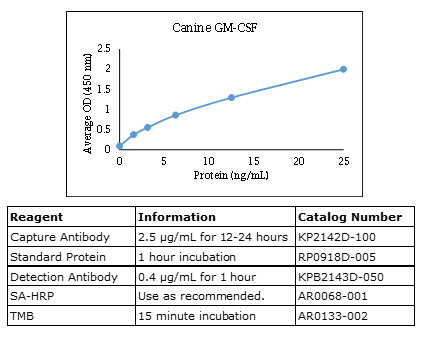
Canine GM-CSF Polyclonal Antibody - Biotinylated
- Catalog Number:
- KPB2143D
- Availability:
- In stock
- Application:
- ELISA, ELISpot
- Host:
- Rabbit
- 100% Homology:
- Canis lupus dingo (dingo), Canis lupus familiaris (dog)
- Label:
- Biotin
 Powered by Bioz
 - The Canine GM-CSF polyclonal antibody is labeled and has been qualified for use in ELISA applications. It is the detection antibody in the Kingfisher Biotech Canine GM-CSF ELISA. The Canine GM-CSF antibody was produced in rabbits and is antigen-affinity purified. The Canine GM-CSF polyclonal antibody has been shown to not cross-react with bat, bovine, caprine, chicken, cynomolgus monkey, equine, feline, human, mouse, ovine, rabbit, rat, or swine GM-CSF. For research use only.
- Recombinant canine GM-CSF - Strong Recombinant bat GM-CSF - None Recombinant bovine GM-CSF - None Recombinant caprine GM-CSF - None Recombinant chicken GM-CSF - None Recombinant cynomolgus monkey GM-CSF - None Recombinant equine GM-CSF - None Recombinant feline GM-CSF - None Recombinant human GM-CSF
| Storage Conditions | 2°C to 8°C |
| Purification | Antigen-affinity |
| Country Of Origin | USA |
Canine GM-CSF (Granulocyte–Macrophage Colony-Stimulating Factor, CSF2) is a hematopoietic cytokine belonging to the colony-stimulating factor family, which also includes G-CSF (CSF3) and M-CSF (CSF1) that regulate the development, proliferation, and activation of myeloid immune cells. In dogs (Canis lupus familiaris), GM-CSF is produced by activated T lymphocytes, macrophages, endothelial cells, fibroblasts, and other stromal cells in response to infection, inflammatory cytokines, or immune stimulation. Canine GM-CSF binds to the GM-CSF receptor (CSF2R) expressed on hematopoietic progenitor cells and mature myeloid cells, activating intracellular signaling pathways such as JAK/STAT, MAPK/ERK, and PI3K–AKT, which promote the proliferation and differentiation of granulocytes, macrophages, and dendritic cells, as well as enhance their functional activity in host defense and antigen presentation. In canine health, GM-CSF contributes to innate and adaptive immune responses during infection and inflammation, particularly through regulation of macrophage and neutrophil activity. Dogs are also valuable comparative animal models for human cancer immunology, and GM-CSF has been studied in canine melanoma models, where GM-CSF–expressing tumor vaccines have been used to stimulate dendritic cell activation and anti-tumor immune responses, providing insights relevant to both veterinary oncology and human cancer immunotherapy.
Citations
50 ug
Price: $400.00
RELATED MEDIA

