Slide 1 of 1 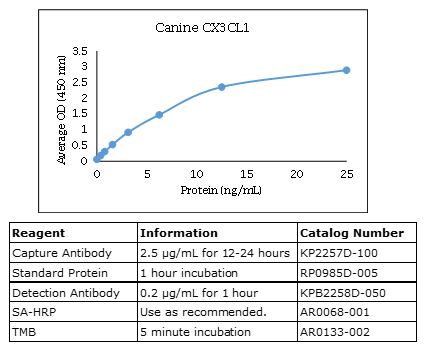
Canine CX3CL1 (Fractalkine) Polyclonal Antibody - Biotinylated
- Catalog Number:
- KPB2258D
- Availability:
- In stock
- Application:
- ELISA, ELISpot, Flow Cytometry, Neutralization, Western Blot
- Host:
- Rabbit
- 100% Homology:
- Canis lupus dingo (dingo), Canis lupus familiaris (dog)
- Label:
- Biotin
 Powered by Bioz
 - The Canine CX3CL1 polyclonal antibody is labeled and has been qualified for use in ELISA applications. It is the detection antibody in the Kingfisher Biotech Canine CX3CL1 ELISA. The Canine CX3CL1 antibody was produced in rabbits and is antigen-affinity purified. This antibody has shown no cross-reactivity with bovine, chicken, ferret/mink, human, or swine CX3CL1 proteins. For research use only.
| Storage Conditions | 2°C to 8°C |
| Purification | Antigen-affinity |
| Country Of Origin | USA |
Canine CX3CL1 (C-X3-C motif chemokine ligand 1), also known as fractalkine, is a chemokine belonging to the CX3C chemokine family, characterized by three amino acids separating the first two conserved cysteine residues. CX3CL1 is unique among chemokines because it exists in both a membrane-bound form and a soluble form, allowing it to function in both leukocyte adhesion and chemotaxis. In dogs (Canis lupus familiaris), CX3CL1 is produced primarily by endothelial cells, epithelial cells, neurons, and macrophages in response to infection, inflammatory cytokines, or tissue injury. CX3CL1 binds to its receptor CX3CR1, which is expressed on monocytes, macrophages, natural killer (NK) cells, and subsets of T lymphocytes, promoting adhesion, migration, and activation of these immune cells at sites of inflammation. In canine health, CX3CL1 contributes to immune responses in inflammatory diseases, infectious conditions, and tissue injury, particularly in the central nervous system and cardiovascular tissues where fractalkine signaling regulates leukocyte–endothelial interactions. Dogs also serve as comparative animal models for human inflammatory and neurological diseases, and the CX3CL1–CX3CR1 pathway has been studied in canine models of neuroinflammation and spinal cord injury, where fractalkine signaling influences microglial activation and immune cell recruitment in damaged neural tissue. These studies help improve understanding of chemokine-mediated neuroimmune interactions and inflammatory mechanisms relevant to both veterinary medicine and human neurological disease research.
Citations
50 ug
Price: $400.00
RELATED MEDIA

