Slide 1 of 1 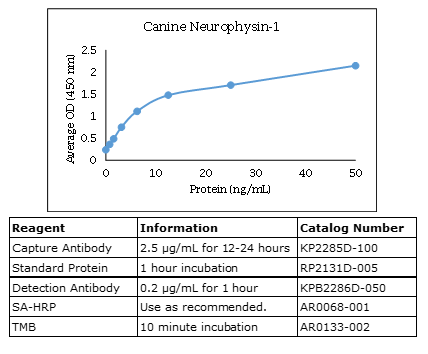
Canine Neurophysin-1 Polyclonal Antibody - Biotinylated
- Catalog Number:
- KPB2286D
- Availability:
- In stock
- Application:
- ELISA, ELISpot, Flow Cytometry, Neutralization, Western Blot
- Host:
- Rabbit
- 100% Homology:
- Canis lupus familiaris (dog)
- Label:
- Biotin
 Powered by Bioz
 - The Canine Neurophysin-1 polyclonal antibody is labeled and has been qualified for use in ELISA applications. It is the detection antibody in the Kingfisher Biotech Canine Neurophysin-1 ELISA. The Canine Neurophysin-1 antibody was produced in rabbits and is antigen-affinity purified. For research use only.
| Storage Conditions | 2°C to 8°C |
| Purification | Antigen-affinity |
| Country Of Origin | USA |
Canine Neurophysin-1 is a carrier protein involved in the synthesis, processing, and transport of the neurohypophyseal hormone oxytocin in dogs (Canis lupus familiaris). Neurophysin-1 is produced as part of a larger precursor protein, preprooxyphysin, in magnocellular neurons of the hypothalamus, particularly within the paraventricular and supraoptic nuclei. During post-translational processing, the precursor is cleaved to generate oxytocin and its associated carrier protein, neurophysin-1. Canine neurophysin-1 binds oxytocin with high affinity, facilitating its proper folding, intracellular transport along axons, and storage in secretory vesicles within the posterior pituitary gland. Upon neuronal stimulation, oxytocin and neurophysin-1 are released together into the circulation. Through this coordinated processing and secretion pathway, neurophysin-1 plays an essential role in regulating oxytocin-mediated physiological functions such as uterine contraction during parturition, milk ejection during lactation, and aspects of social and reproductive behavior in dogs. In cell culture and neuroendocrine research, recombinant canine neurophysin-1 or expression constructs are used to study neurohypophyseal hormone biosynthesis, peptide hormone processing, and mechanisms of hormone storage and secretion in neuroendocrine cells.
Citations
50 ug
Price: $400.00
RELATED MEDIA

