Slide 1 of 1 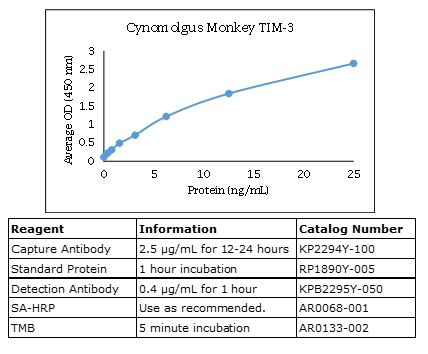
Cynomolgus Monkey TIM-3 Polyclonal Antibody - Biotinylated
- Catalog Number:
- KPB2295Y
- Availability:
- In stock
- Application:
- ELISA, ELISpot, Flow Cytometry, Neutralization, Western Blot
- Host:
- Rabbit
- 100% Homology:
- Macaca fascicularis (crab-eating macaque)
- Label:
- Biotin
 Powered by Bioz
 - The Cynomolgus Monkey TIM-3 polyclonal antibody is labeled and has been qualified for use in ELISA applications. It is the detection antibody in the Kingfisher Biotech Cynomolgus Monkey TIM-3 ELISA. The Cynomolgus Monkey TIM-3 antibody was produced in rabbits and is antigen-affinity purified. This antibody has shown no cross-reactivity with bat, bovine, dolphin, or mouse TIM-3 proteins. For research use only.
| Storage Conditions | 2°C to 8°C |
| Purification | Antigen-affinity |
| Country Of Origin | USA |
Cynomolgus Monkey (Macaca fascicularis) TIM-3 (T cell immunoglobulin and mucin domain-containing protein 3, also known as HAVCR2) is an immune checkpoint receptor that regulates T cell activation, immune tolerance, and inflammatory responses in nonhuman primates. TIM-3 is a member of the TIM (T cell immunoglobulin and mucin domain) family of immune regulatory proteins, which includes TIM-1, TIM-3, and TIM-4, molecules that modulate immune activation and maintain immune homeostasis. In cynomolgus monkeys, TIM-3 is expressed on activated CD4⁺ and CD8⁺ T lymphocytes, natural killer (NK) cells, dendritic cells, and macrophages, where it functions primarily as a negative regulator of immune responses. Interaction of TIM-3 with ligands such as galectin-9, phosphatidylserine, and HMGB1 delivers inhibitory signals that suppress T cell proliferation, cytokine production, and cytotoxic activity, helping prevent excessive immune-mediated tissue damage. Because cynomolgus monkeys are widely used in preclinical infectious disease and immunology research, TIM-3 is frequently studied in models of chronic viral infections (such as SIV/HIV), tuberculosis, and cancer, where increased TIM-3 expression is associated with T cell exhaustion and impaired immune responses. As a key immune checkpoint molecule, cynomolgus monkey TIM-3 is important for studies of immune regulation, host–pathogen interactions, and evaluation of immunotherapies targeting checkpoint pathways, providing translational insight relevant to human disease.
Citations
50 ug
Price: $400.00
RELATED MEDIA
