Slide 1 of 1 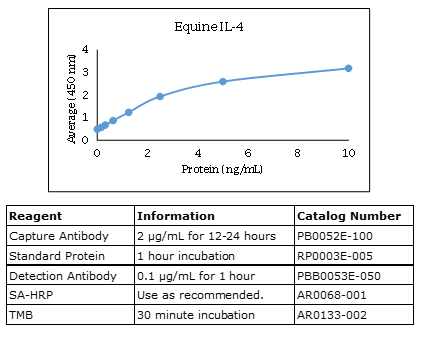
Equine IL-4 Polyclonal Antibody
- Catalog Number:
- PB0052E
- Availability:
- In stock
- Application:
- ELISA, ELISpot, Flow Cytometry, Neutralization, Western Blot
- Host:
- Goat
- 100% Homology:
- Equus asinus (ass), Equus caballus (horse), Equus przewalskii (Przewalski's horse), Equus zebra hartmannae (Hartmann's mountain zebra)
- Label:
- Unconjugated
 Powered by Bioz
 - The Equine IL-4 polyclonal antibody is unlabeled and has been qualified for use in ELISA and Western blot applications. The Equine IL-2 polyclonal antibody was produced in goats and is antigen-affinity purified. The reactivity by species is: (Bovine IL-4 - None) (Chicken IL-4 - None) (Equine IL-4 - Strong) (Feline IL-4 - None) (Human IL-4 - None) (Rabbit IL-4 - None) (Swine IL-4 - None). For research use only.
| Storage Conditions | 2°C to 8°C |
| Purification | Antigen-affinity |
| Country Of Origin | USA |
Equine Interleukin-4 (IL-4) is a Th2-associated cytokine produced primarily by activated CD4⁺ T helper 2 (Th2) cells, mast cells, and basophils in horses (Equus caballus), where it plays a central role in regulating humoral immunity, allergic inflammation, and alternative macrophage activation. IL-4 signals through receptor complexes containing IL-4Rα paired with the common gamma chain (γc) or IL-13Rα1, activating JAK/STAT6 pathways that promote B-cell proliferation, antibody production (including IgE-associated responses), and suppression of Th1-associated cytokines such as IFN-γ. In equine health, IL-4 is particularly important in allergic and hypersensitivity conditions such as equine asthma (recurrent airway obstruction), insect bite hypersensitivity (“sweet itch”), and certain forms of inflammatory bowel disease, where Th2 polarization contributes to eosinophilic inflammation, airway hyperreactivity, and pruritic skin lesions. IL-4 also influences immune responses to parasitic infections by supporting humoral immunity and mucosal repair. While protective in promoting antibody-mediated defense and limiting excessive inflammation, dysregulated or persistent IL-4 signaling may contribute to chronic allergic disease and tissue remodeling. As a biomarker of type 2 immune activation, equine IL-4 is relevant in vaccine development, allergy research, and immune modulation strategies. In translational research, horses serve as valuable large-animal models for human asthma and allergic airway disease, and characterization of equine IL-4 supports comparative investigations into Th2-mediated inflammation and development of targeted cytokine therapies relevant to both veterinary and human medicine.
Citations
Please choose a size to see price
RELATED MEDIA

