Slide 1 of 1 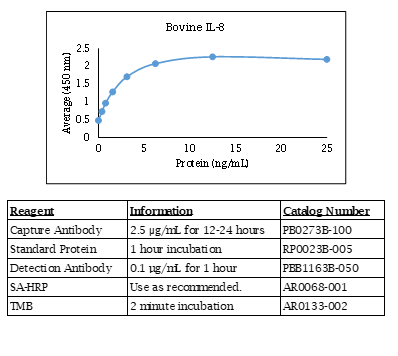
Bovine IL-8 Polyclonal Antibody
- Catalog Number:
- PB0273B
- Availability:
- In stock
- Application:
- ELISA, ELISpot, Flow Cytometry, Neutralization, Western Blot
- Host:
- Rabbit
- 100% Homology:
- Bos indicus (zebu), Bos taurus (cattle)
- Label:
- Unconjugated
 Powered by Bioz
 - Anti-bovine IL-8 polyclonal antibody (catalog PB0273B) is made in rabbits, affinity-purified by bovine IL-8 affinity chromatography and supplied in PBS containing 0.09% NaN₃; it was raised against recombinant bovine IL-8 (immunogen) and the calculated molecular weight of bovine IL-8 is ~9.1 kDa. Store at 2-8°C (stable up to 12 months from date of receipt). Recommended working concentrations are Western blot 0.1-2 µg/mL and ELISA 1-5 µg/mL (optimize per assay); typical sandwich ELISA reagent pairings and suggested conditions are provided on the datasheet (capture antibody PB0273B; standard protein RP0023B-005; detection antibody PB0273B (biotinylated); streptavidin-HRP AR0068-001; TMB substrate AR0133-002). In cross-reactivity testing (ELISA) this antibody shows no reactivity to Atlantic salmon, catfish, chicken, cynomolgus monkey, equine, feline, ferret, guinea pig, human, mallard, rabbit, swine, turkey or zebrafish IL-8; moderate reactivity to canine IL-8; and weak reactivity to bat, dolphin and ovine IL-8. It is commonly used for ELISA, ELISpot, flow cytometry, neutralization, and Western blot applications (users should validate and optimize conditions for each application). The product is made in the USA, supplied for research applications only, and is not intended for medicinal, diagnostic, or therapeutic use.
| Storage Conditions | 2°C to 8°C |
| Purification | Antigen-affinity |
| Country Of Origin | USA |
Bovine Interleukin-8 (IL-8), also known as CXCL8, is a potent pro-inflammatory chemokine that plays a central role in innate immune responses in cattle (Bos taurus) by mediating neutrophil chemotaxis, activation, and migration to sites of infection or tissue injury. Produced by macrophages, epithelial cells, endothelial cells, and mammary gland cells in response to bacterial components, viral infection, and inflammatory cytokines, bovine IL-8 signals primarily through CXCR1 and CXCR2 receptors to activate downstream pathways that promote leukocyte recruitment and amplification of acute inflammation. IL-8 is especially important in economically significant conditions such as mastitis, bovine respiratory disease (BRD), endometritis, and enteric infections, where elevated IL-8 levels drive neutrophil infiltration into affected tissues, contributing to both pathogen clearance and inflammatory tissue damage. In the mammary gland, IL-8 is a key mediator of somatic cell recruitment during intramammary infection and serves as an early biomarker of mastitis severity and treatment response. In animal health and translational research, characterization of bovine IL-8 supports studies of mucosal immunity, host-pathogen interactions, inflammatory regulation, and genetic factors influencing disease resistance, while also providing comparative insights into neutrophil-driven inflammatory processes relevant to human respiratory and inflammatory diseases.
Citations
Please choose a size to see price
RELATED MEDIA

