Slide 1 of 1 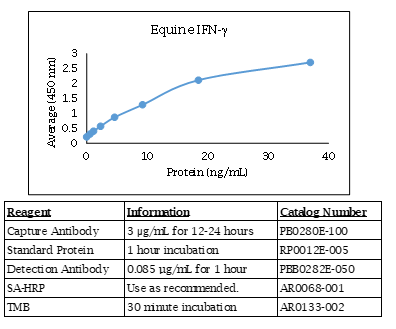
Equine IFN gamma Polyclonal Antibody
- Catalog Number:
- PB0280E
- Availability:
- In stock
- Application:
- ELISA, ELISpot, Flow Cytometry, Neutralization, Western Blot
- Host:
- Rabbit
- 100% Homology:
- Equus caballus (horse)
- Label:
- Unconjugated
 Powered by Bioz
 - The Equine IFN gamma polyclonal antibody is unlabeled and has been qualified for use in ELISA and Western blot applications. The Equine IFN gamma polyclonal antibody was produced in rabbits and is antigen-affinity purified. The reactivity by species is: (Bovine IFN-gamma - Weak) (Canine IFN-gamma - Moderate) (Chicken IFN-gamma - None) (Dolphin IFN-gamma - Moderate) (Equine IFN-gamma - Strong) (Feline IFN-gamma - Weak) (Human IFN-gamma - Moderate) (Mouse IFN-gamma - Weak) (Rabbit IFN-gamma - Weak) (Swine IFN-gamma - Weak). For research use only.
| Storage Conditions | 2°C to 8°C |
| Purification | Antigen-affinity |
| Country Of Origin | USA |
Equine Interferon-γ (IFN-γ) is a type II interferon cytokine that plays a central role in cell-mediated immunity and regulation of antimicrobial responses in horses (Equus caballus). IFN-γ is primarily produced by activated T helper 1 (Th1) lymphocytes, cytotoxic T cells, and natural killer (NK) cells following stimulation by intracellular pathogens or inflammatory cytokines. Equine IFN-γ binds to the interferon-γ receptor (IFNGR) expressed on many immune and non-immune cells, activating intracellular signaling through the JAK–STAT pathway, particularly STAT1, which induces transcription of interferon-stimulated genes involved in antimicrobial defense, antigen presentation, and immune regulation. In horses, IFN-γ is critical for macrophage activation, enhanced antigen presentation via MHC molecules, and control of intracellular pathogens. In equine health, IFN-γ contributes to immune responses against infectious diseases such as equine herpesvirus and Rhodococcus equi infections. Horses are also used as animal models for respiratory and intracellular bacterial infections, and IFN-γ–mediated immune responses have been studied in foal models of Rhodococcus equi pneumonia, where IFN-γ–driven macrophage activation is important for controlling intracellular bacterial replication, providing insights relevant to both equine infectious disease and comparative studies of pulmonary immunity.
Citations
Please choose a size to see price
RELATED MEDIA

