Slide 1 of 1 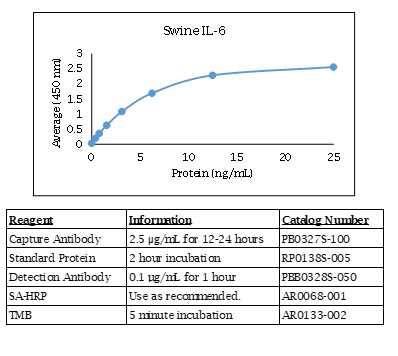
Swine IL-6 Polyclonal Antibody
- Catalog Number:
- PB0327S
- Availability:
- In stock
- Application:
- ELISA, ELISpot, Flow Cytometry, Neutralization, Western Blot
- Host:
- Rabbit
- 100% Homology:
- Sus scrofa (pig)
- Label:
- Unconjugated
 Powered by Bioz
 - Anti-swine IL-6 polyclonal antibody (catalog PB0327S) is made in rabbits, affinity-purified (swine IL-6 affinity chromatography) and supplied in PBS containing 0.09% NaN₃; it was raised against recombinant swine IL-6 (immunogen) and the calculated molecular weight of swine IL-6 is ~20.9 kDa. Store at 2-8°C (stable up to 12 months from date of receipt). Recommended working concentrations are Western blot 0.1-2 µg/mL and ELISA 1-5 µg/mL (optimize per assay); typical sandwich ELISA reagent pairings and suggested conditions are provided on the datasheet (capture antibody PB0327S; standard protein RP0138S-005; detection antibody PBB0328S-050; streptavidin-HRP AR0068-001; TMB substrate AR0133-002). In cross-reactivity testing (ELISA) this antibody shows no reactivity to Atlantic salmon, bovine, canine, caprine, chicken, cynomolgus monkey, equine, feline, human, mouse, ovine, rabbit, rat or zebrafish IL-6, and weak reactivity to dolphin IL-6. It is commonly used for ELISA, ELISpot, flow cytometry, neutralization, and Western blot applications (users should validate and optimize conditions for each application). The product is made in the USA, supplied for research applications only, and is not intended for medicinal, diagnostic, or therapeutic use.
| Storage Conditions | 2°C to 8°C |
| Purification | Antigen-affinity |
| Country Of Origin | USA |
Swine Interleukin-6 (IL-6) is a multifunctional pro-inflammatory cytokine and a central member of the IL-6 cytokine family—including IL-6, IL-11, IL-27, IL-31, leukemia inhibitory factor (LIF), oncostatin M (OSM), ciliary neurotrophic factor (CNTF), cardiotrophin-1 (CT-1), and cardiotrophin-like cytokine factor 1 (CLCF1)—which signal through receptor complexes containing the shared gp130 subunit to activate JAK/STAT and MAPK pathways. In pigs (Sus scrofa domesticus), IL-6 is rapidly produced by macrophages, monocytes, endothelial cells, and epithelial cells in response to infection, tissue injury, and stress, where it regulates acute-phase protein synthesis (including C-reactive protein, haptoglobin, and serum amyloid A), fever, leukocyte activation, and B- and T-cell differentiation. Elevated IL-6 levels are associated with economically significant diseases such as porcine reproductive and respiratory syndrome (PRRS), swine influenza, African swine fever, bacterial sepsis, enteric infections, and post-weaning multisystemic wasting syndrome, where dysregulated IL-6 responses can contribute to systemic inflammation and reduced growth performance. As both a biomarker of immune activation and a mediator of disease severity, swine IL-6 is widely used in herd health monitoring, vaccine evaluation, and immunopathogenesis studies. In translational research, pigs serve as valuable large-animal models due to physiological and immunological similarities to humans, and characterization of swine IL-6 and related family members supports studies in infectious disease, sepsis, trauma, metabolic disorders, and immunomodulatory therapeutic development.
Citations
Please choose a size to see price
RELATED MEDIA

