Slide 1 of 1 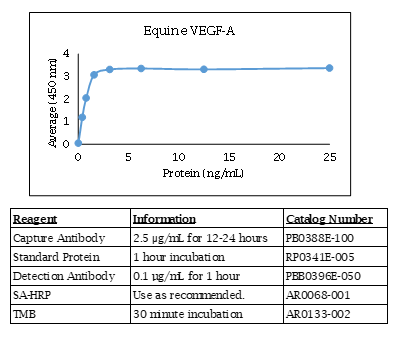
Equine VEGF-A Polyclonal Antibody
- Catalog Number:
- PB0388E
- Availability:
- In stock
- Application:
- ELISA, ELISpot, Flow Cytometry, Neutralization, Western Blot
- Host:
- Goat
- 100% Homology:
- Equus asinus (ass), Equus caballus (horse)
- Label:
- Unconjugated
 Powered by Bioz
 - The Equine VEGF-A polyclonal antibody is unlabeled and has been qualified for use in ELISA and Western blot applications. It is the capture antibody in the Kingfisher Biotech Equine VEGF-A ELISA. The Equine VEGF-A polyclonal antibody was produced in goats and is antigen-affinity purified. The reactivity by species is: (Bovine VEGF-A - Weak) (Canine VEGF-A - Weak) (Equine VEGF-A - Strong) (Mouse VEGF-A - Weak) (Rat VEGF-A - Weak) (Swine VEGF-A - Moderate). For research use only.
| Storage Conditions | 2°C to 8°C |
| Purification | Antigen-affinity |
| Country Of Origin | USA |
Equine Vascular Endothelial Growth Factor A (VEGF-A) is a member of the vascular endothelial growth factor (VEGF) family, which includes VEGF-A, VEGF-B, VEGF-C, VEGF-D, and placental growth factor (PlGF)—key regulators of angiogenesis, vascular development, and endothelial cell function. In horses (Equus caballus), VEGF-A is produced by a variety of cells including endothelial cells, macrophages, fibroblasts, epithelial cells, and muscle cells, particularly in response to hypoxia, inflammation, exercise-induced stress, or tissue injury. VEGF-A exerts its biological effects primarily through binding to VEGF receptor-1 (VEGFR-1/Flt-1) and VEGF receptor-2 (VEGFR-2/KDR) on endothelial cells, activating intracellular signaling pathways such as MAPK/ERK, PI3K/AKT, and PLCγ, which promote endothelial cell proliferation, migration, vascular permeability, and formation of new blood vessels. In equine physiology, VEGF-A plays important roles in vascular development, wound healing, and tissue regeneration, particularly in musculoskeletal tissues such as tendon, ligament, and bone. VEGF-A is also involved in exercise-induced vascular adaptation in skeletal muscle, which is important for athletic performance in horses. Dysregulated VEGF signaling may contribute to abnormal tissue remodeling or tumor angiogenesis in certain equine diseases. Because horses are frequently studied in sports medicine, musculoskeletal injury repair, and regenerative therapies, equine VEGF-A is an important focus in research on angiogenesis, tissue healing, and vascular adaptation relevant to equine health and performance.
Citations
Please choose a size to see price
RELATED MEDIA

