Slide 1 of 1 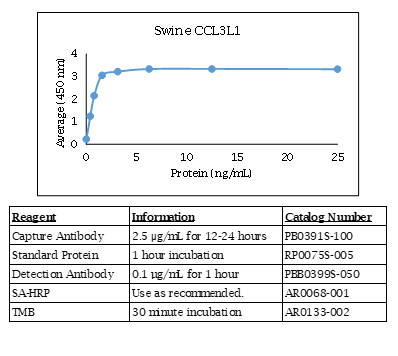
Swine CCL3L1 Polyclonal Antibody
- Catalog Number:
- PB0391S
- Availability:
- In stock
- Application:
- ELISA, ELISpot, Flow Cytometry, Neutralization, Western Blot
- Host:
- Rabbit
- 100% Homology:
- Sus scrofa (pig)
- Label:
- Unconjugated
 Powered by Bioz
 - Anti-swine CCL3L1 (MIP-1α) polyclonal antibody (catalog PB0391S) is made in rabbits, affinity-purified by swine CCL3L1 affinity chromatography and supplied in PBS containing 0.09% NaN₃; it was raised against recombinant swine CCL3L1 (immunogen) and the calculated molecular weight of swine CCL3L1 is ~7.8 kDa. Store at 2-8°C (stable up to 12 months from date of receipt). Recommended working concentrations are Western blot 0.1-2 µg/mL and ELISA 0.5-5 µg/mL (optimize per assay); typical sandwich ELISA reagent pairings and suggested conditions are provided on the datasheet (capture antibody PB0391S; standard protein RP0075S-005; detection antibody PBB0399S; streptavidin-HRP AR0068-001; TMB substrate AR0133-002). It is commonly used for ELISA, ELISpot, flow cytometry, neutralization, and Western blot applications (users should validate and optimize conditions for each application). The product is made in the USA, supplied for research applications only, and is not intended for medicinal, diagnostic, or therapeutic use.
| Storage Conditions | 2°C to 8°C |
| Purification | Antigen-affinity |
| Country Of Origin | USA |
Swine CCL3L1 (C-C motif chemokine ligand 3-like 1, also known as LD78β or MIP-1αP) is a chemokine closely related to CCL3 (MIP-1α) that plays a role in leukocyte recruitment and regulation of inflammatory immune responses in pigs (Sus scrofa domesticus). CCL3L1 primarily signals through the CCR5 receptor, and to a lesser extent CCR1, promoting chemotaxis of monocytes, macrophages, dendritic cells, natural killer (NK) cells, and activated T lymphocytes to sites of infection or tissue injury. In swine, CCL3L1 is produced by activated macrophages, dendritic cells, and lymphocytes in response to inflammatory stimuli such as pathogen-associated molecular patterns and cytokines including TNF-α and IL-1β. CCL3L1-mediated signaling contributes to host defense by coordinating immune cell trafficking and amplifying inflammatory responses during infections, including porcine reproductive and respiratory syndrome virus (PRRSV), swine influenza virus, and bacterial respiratory pathogens involved in porcine respiratory disease complex. Because CCR5-mediated chemokine signaling influences antiviral immunity and immune cell activation, CCL3L1 may also participate in regulation of inflammatory lung responses during respiratory infections. As a regulator of leukocyte migration and inflammatory signaling, swine CCL3L1 is relevant in studies of host–pathogen interactions, immune regulation, and vaccine responses, and contributes to understanding chemokine networks that influence disease resistance and immune function in pigs.
Citations
Please choose a size to see price
RELATED MEDIA

