Slide 1 of 1 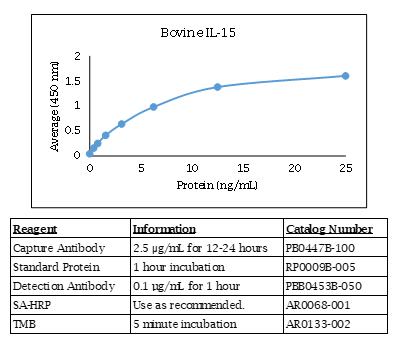
Bovine IL-15 Polyclonal Antibody
- Catalog Number:
- PB0447B
- Availability:
- In stock
- Application:
- ELISA, ELISpot, Flow Cytometry, Neutralization, Western Blot
- Host:
- Goat
- 100% Homology:
- Bos indicus (zebu), Bos mutus (wild yak), Bos taurus (cattle), Bubalus bubalis (water buffalo), Bubalus kerabau (carabao), Moschus berezovskii (Chinese forest musk deer)
- Label:
- Unconjugated
 Powered by Bioz
 - The Bovine IL-15 polyclonal antibody is unlabeled and has been qualified for use in ELISA and Western blot applications. It is the capture antibody in the Kingfisher Biotech Bovine IL-15 ELISA. The Bovine IL-15 polyclonal antibody was produced in goats and is antigen-affinity purified. The reactivity by species is: (Bovine IL-15 - Strong) (Chicken IL-15 - None) (Equine IL-15 - Weak) (Guinea Pig IL-15 - Weak) (Swine IL-15 - Weak). For research use only.
| Storage Conditions | 2°C to 8°C |
| Purification | Antigen-affinity |
| Country Of Origin | USA |
Bovine Interleukin-15 (IL-15) is a cytokine that plays a key role in regulating innate and adaptive immune responses in cattle (Bos taurus). IL-15 is produced primarily by monocytes, macrophages, dendritic cells, and other non-lymphoid tissues in response to infection or inflammatory stimuli. Bovine IL-15 signals through a heterotrimeric receptor complex composed of IL-15Rα, IL-2/15Rβ (CD122), and the common γ chain (γc), activating intracellular signaling pathways including JAK1/3 and STAT3/5 that promote lymphocyte proliferation, survival, and activation. In cattle, IL-15 is particularly important for the development, maintenance, and activation of natural killer (NK) cells and memory CD8⁺ T cells, supporting cytotoxic responses against infected or abnormal cells. It also contributes to regulation of mucosal immunity and inflammatory responses during infection. Bovine IL-15 has been studied in the context of immune responses to important livestock pathogens such as Mycobacterium bovis, bovine viral diarrhea virus (BVDV), and Mycobacterium avium subsp. paratuberculosis. Due to its role in regulating cellular immunity and lymphocyte homeostasis, bovine IL-15 is widely investigated in veterinary immunology and translational research, including studies of vaccine development, host–pathogen interactions, and immune modulation relevant to cattle health and comparative biomedical research.
Citations
Please choose a size to see price
RELATED MEDIA

