Slide 1 of 1 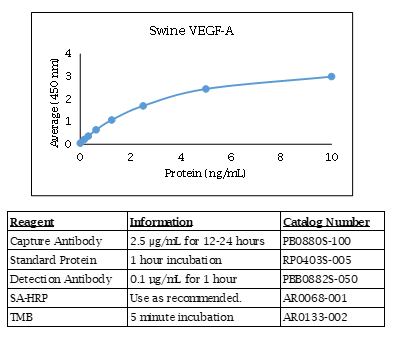
Swine VEGF-A Polyclonal Antibody
- Catalog Number:
- PB0880S
- Availability:
- In stock
- Application:
- ELISA, ELISpot, Flow Cytometry, Neutralization, Western Blot
- Host:
- Goat
- 100% Homology:
- Phacochoerus africanus (Common warthog), Sus scrofa (pig)
- Label:
- Unconjugated
 Powered by Bioz
 - The Swine VEGF-A polyclonal antibody is unlabeled and has been qualified for use in ELISA and Western blot applications. It is the capture antibody in the Kingfisher Biotech Swine VEGF-A ELISA. The Swine VEGF-A polyclonal antibody was produced in goats and is antigen-affinity purified. The reactivity by species is: (Bovine VEGF-A - Weak) (Canine VEGF-A - Strong) (Equine VEGF-A - Moderate) (Feline VEGF-A - Strong) (Mouse VEGF-A - Moderate) (Ovine VEGF-A - Weak) (Rat VEGF-A - Weak) (Swine VEGF-A - Strong). For research use only.
| Storage Conditions | 2°C to 8°C |
| Purification | Antigen-affinity |
| Country Of Origin | USA |
Swine Vascular Endothelial Growth Factor A (VEGF-A) is a member of the vascular endothelial growth factor (VEGF) family, which includes VEGF-A, VEGF-B, VEGF-C, VEGF-D, and placental growth factor (PlGF)—key regulators of angiogenesis, vascular permeability, and endothelial cell growth. In pigs (Sus scrofa), VEGF-A is produced by multiple cell types including endothelial cells, macrophages, fibroblasts, epithelial cells, smooth muscle cells, and tumor cells, particularly in response to hypoxia, inflammation, and tissue injury. VEGF-A exerts its biological effects primarily through binding to VEGF receptor-1 (VEGFR-1/Flt-1) and VEGF receptor-2 (VEGFR-2/KDR) on endothelial cells, activating intracellular signaling pathways such as MAPK/ERK, PI3K/AKT, and PLCγ, which promote endothelial cell proliferation, migration, vascular permeability, and formation of new blood vessels. In swine physiology, VEGF-A plays important roles in vascular development, tissue regeneration, reproductive physiology, and placental angiogenesis, supporting maternal–fetal blood supply during pregnancy. VEGF-A is also involved in muscle vascularization and tissue repair following injury or ischemia. Because pigs share many physiological similarities with humans, swine VEGF-A is widely studied in large-animal models of cardiovascular disease, ischemia, wound healing, and regenerative medicine, contributing to translational research on angiogenesis and therapeutic strategies targeting VEGF signaling.
Citations
Please choose a size to see price
RELATED MEDIA

