Slide 1 of 1 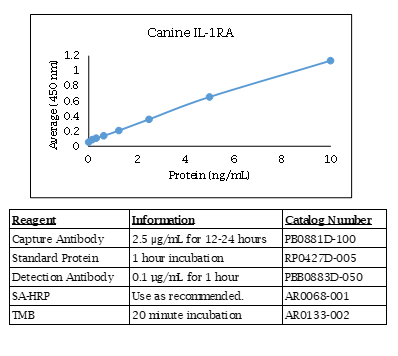
Canine IL-1 Receptor Antagonist (IL-1RA) Polyclonal Antibody
- Catalog Number:
- PB0881D
- Availability:
- In stock
- Application:
- ELISA, ELISpot, Flow Cytometry, Neutralization, Western Blot
- Host:
- Goat
- 100% Homology:
- Canis lupus dingo (dingo), Canis lupus familiaris (dog), Nyctereutes procyonoides (raccoon dog), Vulpes lagopus (Arctic fox), Vulpes vulpes (red fox)
- Label:
- Unconjugated
 Powered by Bioz
 - Anti-canine IL-1RA polyclonal antibody (catalog PB0881D) is made in goats, affinity-purified by canine IL-1RA affinity chromatography and supplied in PBS containing 0.09% NaN₃; it was raised against recombinant canine IL-1RA (immunogen) and the calculated molecular weight of canine IL-1RA is ~16.7 kDa. Store at 2-8°C (stable up to 12 months from date of receipt). Recommended working concentrations are Western blot 1-10 µg/mL and ELISA 0.5-5 µg/mL (optimize per assay); typical sandwich ELISA reagent pairings and suggested conditions are provided on the datasheet (capture antibody PB0881D; standard protein RP0427D-005; detection antibody PBB0883D; streptavidin-HRP AR0068-001; TMB substrate AR0133-002). In cross-reactivity testing (ELISA) this antibody shows no reactivity to bovine or chicken IL-1RA, weak reactivity to dolphin, equine and swine IL-1RA, and moderate reactivity to mouse IL-1RA. It is commonly used for ELISA, ELISpot, flow cytometry, neutralization, and Western blot applications (users should validate and optimize conditions for each application). The product is made in the USA, supplied for research applications only, and is not intended for medicinal, diagnostic, or therapeutic use.
| Storage Conditions | 2°C to 8°C |
| Purification | Antigen-affinity |
| Country Of Origin | USA |
Canine Interleukin-1 Receptor Antagonist (IL-1Ra) is an anti-inflammatory cytokine produced by monocytes, macrophages, neutrophils, and other immune cells in dogs (Canis lupus familiaris) that serves as a natural regulator of IL-1–mediated inflammation. IL-1Ra competitively binds to the IL-1 receptor type 1 (IL-1R1) without activating downstream signaling, thereby blocking the pro-inflammatory effects of IL-1α and IL-1β and limiting activation of NF-κB and MAPK pathways that drive fever, leukocyte recruitment, and tissue inflammation. In canine health, IL-1Ra plays an important role in modulating inflammatory conditions such as osteoarthritis, immune-mediated polyarthritis, atopic dermatitis, inflammatory bowel disease, sepsis, and other inflammatory or infectious diseases where excessive IL-1 signaling contributes to pathology. In joint disease specifically, IL-1Ra helps counteract IL-1β–driven cartilage degradation and synovial inflammation, making it relevant to therapeutic strategies including biologic and regenerative medicine approaches. As both a biomarker of anti-inflammatory regulation and a therapeutic target, canine IL-1Ra is important in veterinary medicine for monitoring inflammatory balance and evaluating treatment efficacy. In translational research, dogs serve as valuable spontaneous models for human osteoarthritis, autoimmune disorders, and inflammatory diseases, and characterization of canine IL-1Ra supports studies of cytokine network regulation, resolution of inflammation, and development of targeted immunomodulatory therapies relevant to both canine and human health.
Citations
Please choose a size to see price
RELATED MEDIA

