Slide 1 of 1 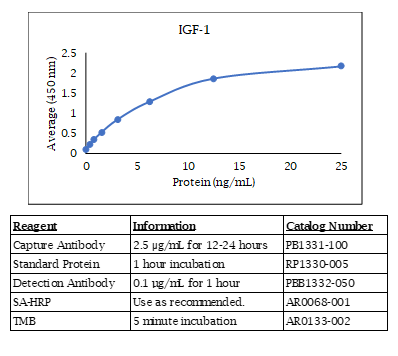
Multi-species (Cattle, Dog, Dolphin, Goat, Guinea Pig, Horse, Cat, Human, Mink, Monkey, Ferret, Pig, Bat) IGF-1 Polyclonal Antibody
- Catalog Number:
- PB1331
- Availability:
- In stock
- Application:
- ELISA, ELISpot, Flow Cytometry, Neutralization, Western Blot
- Host:
- Goat
- 100% Homology:
- Ailuropoda melanoleuca (giant panda), Bison bison bison (American Buffalo), Bos indicus (zebu), Bos mutus (wild yak), Bos taurus (cattle), Bubalus bubalis (water buffalo), Camelus bactrianus (Bactrian camel), Camelus ferus (Wild Bactrian camel), Canis lupus familiaris (dog), Capra hircus (goat), Carlito syrichta (Philippine tarsier), Cavia porcellus (domestic guinea pig), Ceratotherium simum simum (southern white rhinoceros), Cercocebus atys (sooty mangabey), Chinchilla lanigera (long-tailed chinchilla), Chlorocebus sabaeus (green monkey), Dipodomys ordii (Ord's kangaroo rat), Equus asinus (ass), Equus caballus (horse), Equus przewalskii (Przewalski's horse), Felis catus (domestic cat), Gorilla gorilla gorilla (western lowland gorilla), Homo sapiens (human), Ictidomys tridecemlineatus (thirteen-lined ground squirrel), Leptonychotes weddellii (Weddell seal), Lipotes vexillifer (Yangtze River dolphin), Macaca fascicularis (crab-eating macaque), Macaca mulatta (Rhesus monkey), Macaca nemestrina (pig-tailed macaque), Mandrillus leucophaeus (drill), Manis javanica (Malayan pangolin), Marmota marmota marmota (Alpine marmot), Microcebus murinus (gray mouse lemur), Mustela putorius furo (domestic ferret), Nannospalax galili (Upper Galilee mountains blind mole rat), Neogale vison (American mink), Nomascus leucogenys (northern white-cheeked gibbon), Odobenus rosmarus divergens (Pacific walrus), Orcinus orca (killer whale), Otolemur garnettii (small-eared galago), Pan paniscus (pygmy chimpanzee), Pan troglodytes (chimpanzee), Panthera pardus (leopard), Pantholops hodgsonii (chiru), Papio anubis (olive baboon), Physeter catodon (sperm whale), Pongo abelii (Sumatran orangutan), Pteropus giganteus (Indian flying fox), Pteropus vampyrus (large flying fox), Rhinolophus sinicus (Chinese rufous horseshoe bat), Rhinopithecus bieti (black snub-nosed monkey), Rhinopithecus roxellana (golden snub-nosed monkey), Sus scrofa (pig), Tursiops truncatus (bottlenose dolphin), Vicugna pacos (alpaca)
- Label:
- Unconjugated
 Powered by Bioz
 - The IGF-1 polyclonal antibody is unlabeled and has been qualified for use in ELISA and Western blot applications. It is the capture antibody in the Kingfisher IGF-1 ELISA. The IGF-1 antibody was produced in goats and is antigen-affinity purified. The reactivity by species is: (Bovine IGF-1 - Strong) (Canine IGF-1 - Strong) (Caprine IGF-1 - Strong) (Dolphin IGF-1 - Strong) (Equine IGF-1 - Strong) (Feline IGF-1 - Strong) (Guinea Pig IGF-1 - Strong) (Ferret IGF-1 - Strong) (Human IGF-1 - Strong) (Monkey IGF-1 - Strong) (Turkey IGF-1 - None) (Swine IGF-1 - Strong). For research use only.
| Storage Conditions | 2°C to 8°C |
| Purification | Antigen-affinity |
| Country Of Origin | USA |
Insulin-like Growth Factor 1 (IGF-1) is a highly conserved peptide growth factor that plays a central role in regulating growth, development, tissue maintenance, and metabolic processes in mammals including cattle (Bos taurus), dog (Canis lupus familiaris), dolphin (Delphinidae spp.), goat (Capra hircus), guinea pig (Cavia porcellus), horse (Equus caballus), cat (Felis catus), human (Homo sapiens), mink (Neogale vison), monkey (nonhuman primates), ferret (Mustela putorius furo), pig (Sus scrofa), and bat (order Chiroptera). The IGF-1 protein is identical at the amino acid level among these species, reflecting strong evolutionary conservation and essential biological functions. IGF-1 is produced primarily in the liver in response to growth hormone stimulation and circulates in the bloodstream bound to IGF-binding proteins (IGFBPs), which regulate its stability, transport, and tissue availability. It is also produced locally in many tissues, including muscle, bone, adipose tissue, and the nervous system, where it acts in autocrine and paracrine signaling. IGF-1 binds to the insulin-like growth factor 1 receptor (IGF1R), a transmembrane tyrosine kinase receptor, activating intracellular signaling pathways such as PI3K–AKT and MAPK that regulate cell proliferation, differentiation, survival, and metabolism. Functionally, IGF-1 promotes somatic growth by stimulating skeletal development, chondrocyte proliferation in growth plates, and bone formation, while also enhancing muscle protein synthesis and inhibiting apoptosis in multiple cell types. In addition to its growth-promoting effects, IGF-1 contributes to tissue repair, neuroprotection, immune regulation, and metabolic homeostasis, including modulation of glucose and lipid metabolism. Due to its broad biological roles and cross-species conservation, IGF-1 is widely studied as a key endocrine and paracrine regulator in developmental biology, veterinary science, aging research, and translational biomedical studies.
Citations
Please choose a size to see price
RELATED MEDIA

