Slide 1 of 1 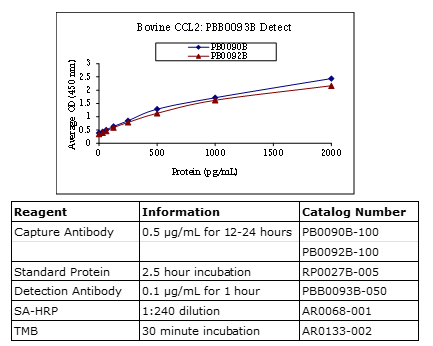
Bovine CCL2 (MCP-1) Polyclonal Antibody - Biotinylated
- Catalog Number:
- PBB0093B
- Availability:
- In stock
- Application:
- ELISA, ELISpot
- Host:
- Rabbit
- 100% Homology:
- Bison bison bison (American buffalo), Bos indicus (zebu), Bos mutus (wild yak), Bos taurus (cattle)
- Label:
- Biotin
 Powered by Bioz
 - The Bovine CCL2 (MCP-1) polyclonal antibody is labeled and has been qualified for use in ELISA and Western blot applications. It is the capture antibody in the Kingfisher Biotech Bovine CCL2 ELISA. The Bovine CCL2 polyclonal antibody was produced in rabbits and is antigen-affinity purified. The reactivity by species is: (Dolphin CCL2 - Strong) (Ovine/Caprine CCL2 - Strong). For research use only.
- Dolphin CCL2 - Strong Ovine/Caprine CCL2 - Strong
| Storage Conditions | 2°C to 8°C |
| Purification | Antigen-affinity |
| Country Of Origin | USA |
Bovine CCL2 (C-C motif chemokine ligand 2, also known as monocyte chemoattractant protein-1, MCP-1) is a pro-inflammatory chemokine that plays a central role in recruitment and activation of monocytes, macrophages, and memory T cells during immune responses in cattle (Bos taurus). CCL2 signals primarily through the CCR2 receptor, triggering intracellular signaling pathways that promote leukocyte migration, cytokine production, and coordination of innate and adaptive immune responses at sites of infection or tissue injury. In bovine health, CCL2 is particularly important in inflammatory conditions such as mastitis, where it mediates recruitment of monocytes and macrophages to infected mammary tissue, as well as in respiratory diseases associated with the bovine respiratory disease complex (BRDC) and infections such as Mycobacterium bovis. While CCL2-driven immune cell recruitment supports pathogen clearance and tissue repair, excessive or prolonged expression can contribute to tissue damage and chronic inflammation. As a biomarker of monocyte/macrophage recruitment and inflammatory activation, bovine CCL2 is widely studied in investigations of host–pathogen interactions, immune responses to bacterial and viral infections, and vaccine efficacy. Characterization of bovine CCL2 supports veterinary research aimed at improving disease resistance, understanding inflammatory disease mechanisms, and enhancing health and productivity in cattle.
Citations
50 ug
Price: $400.00
RELATED MEDIA

