Slide 1 of 1 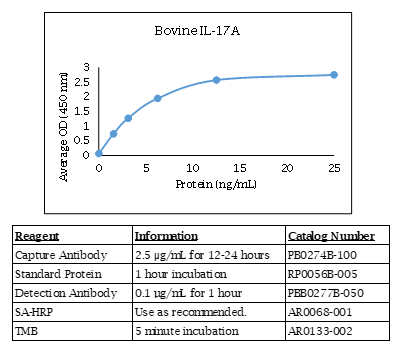
Bovine IL-17A Polyclonal Antibody - Biotinylated
- Catalog Number:
- PBB0277B
- Availability:
- In stock
- Application:
- ELISA, ELISpot
- Host:
- Rabbit
- 100% Homology:
- Bos indicus (zebu), Bos javanicus (banteng), Bos taurus (cattle)
- Label:
- Biotin
 Powered by Bioz
 - The Bovine IL-17A polyclonal antibody is labeled and has been qualified for use in ELISA. It is the detection antibody in the Kingfisher Biotech Bovine IL-17A ELISA. The Bovine IL-17A polyclonal antibody was produced in rabbits and is antigen-affinity purified. The reactivity by species is: (Bovine IL-17A - Strong) (Canine IL-17A - Weak) (Caprine IL-17A - Moderate) (Cynomolgus Monkey IL-17A - Weak) (Dolphin IL-17A - Strong) (Equine IL-17A - None) (Feline IL-17A - Moderate) (Ferret IL-17A - Weak) (Guinea Pig IL-17A - Weak) (Human IL-17A - Weak) (Mouse IL-17A - Weak) (Ovine IL-17A - Strong) (Rabbit IL-17A - Weak) (Rat IL-17A - Weak) (Swine IL-17A - Strong). For research use only.
| Storage Conditions | 2°C to 8°C |
| Purification | Antigen-affinity |
| Country Of Origin | USA |
Bovine IL-17A (Interleukin-17A) is a pro-inflammatory cytokine belonging to the IL-17 family that plays a critical role in host defense and inflammatory responses in cattle (Bos taurus). IL-17A is produced primarily by Th17 cells, as well as by γδ T cells—which are abundant in ruminants—and other innate lymphoid cell populations in response to microbial infection and inflammatory stimulation. It acts on epithelial, endothelial, and stromal cells to induce expression of pro-inflammatory cytokines, chemokines (such as CXCL8), and antimicrobial peptides, thereby promoting neutrophil recruitment and enhancing mucosal and barrier immunity. In healthy cattle, basal IL-17A expression is generally low, but levels increase during bacterial and fungal infections, mastitis, respiratory disease, enteric infections, and parasitic challenges. IL-17A has been implicated in immune responses to pathogens such as Mycobacterium bovis, bovine respiratory disease complex agents, and gastrointestinal nematodes. In veterinary and agricultural research, bovine IL-17A serves as an important biomarker of Th17-mediated immunity and neutrophilic inflammation, providing insight into host–pathogen interactions, vaccine responses, and inflammatory disease mechanisms in cattle.
Citations
50 ug
Price: $400.00
RELATED MEDIA

