Slide 1 of 1 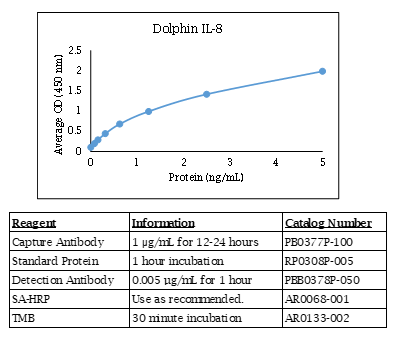
Dolphin IL-8 Polyclonal Antibody - Biotinylated
- Catalog Number:
- PBB0378P
- Availability:
- In stock
- Application:
- ELISA, ELISpot
- Host:
- Rabbit
- 100% Homology:
- Globicephala melas (long-finned pilot whale), Lagenorhynchus obliquidens (Pacific white-sided dolphin), Orcinus orca (killer whale), Tursiops truncatus (common bottlenose dolphin)
- Label:
- Biotin
 Powered by Bioz
 - The Dolphin IL-8 (CXCL8) polyclonal antibody is labeled and has been qualified for use in ELISA. It is the detection antibody in the Kingfisher Biotech Dolphin IL-8 ELISA. The Dolphin IL-8 polyclonal antibody was produced in rabbits and is antigen-affinity purified. The reactivity by species is: (Bovine IL-8 - Weak) (Canine IL-8 - Weak) (Dolphin IL-8 - Strong) (Equine IL-8 - Weak) (Feline IL-8 - Weak) (Guinea Pig IL-8 - None) (Human IL-8 - None) (Rabbit IL-8 - None) (Swine IL-8 - Weak). For research use only.
| Storage Conditions | 2°C to 8°C |
| Purification | Antigen-affinity |
| Country Of Origin | USA |
Dolphin Interleukin-8 (IL-8), also known as CXCL8, is a pro-inflammatory chemokine that plays a central role in innate immune responses in dolphins, particularly the bottlenose dolphin (Tursiops truncatus), by promoting neutrophil chemotaxis, activation, and migration to sites of infection or tissue injury. Produced by macrophages, epithelial cells, and endothelial cells in response to microbial stimuli and inflammatory signaling, dolphin IL-8 likely signals through CXCR1- and CXCR2-like receptors to coordinate leukocyte recruitment and amplification of inflammatory responses. Elevated IL-8 expression has been associated with respiratory infections, bacterial and fungal dermatitis, wound healing, and systemic inflammatory conditions in both free-ranging and managed dolphin populations. Because dolphins are long-lived marine mammals exposed to diverse environmental stressors, including pollutants and harmful algal blooms, IL-8 serves as a valuable biomarker of immune activation and inflammatory status in marine health assessments. In comparative and translational research, dolphins function as sentinel species for ocean and ecosystem health and as models for studying chronic inflammation, stress physiology, and pollutant-associated immune modulation. Characterization of dolphin IL-8 supports investigations into host-pathogen interactions, environmental immunotoxicology, and neutrophil-driven inflammatory mechanisms, providing insight relevant to both marine mammal conservation and human inflammatory disease research.
Citations
50 ug
Price: $400.00
RELATED MEDIA
