Slide 1 of 1 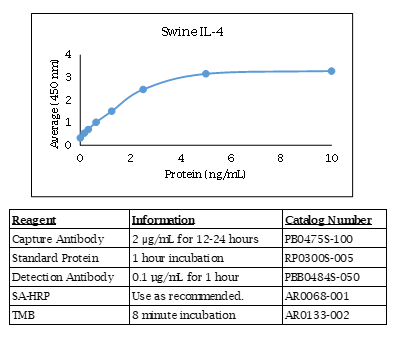
Swine IL-4 Polyclonal Antibody - Biotinylated
- Catalog Number:
- PBB0484S
- Availability:
- In stock
- Application:
- ELISA, ELISpot
- Host:
- Goat
- 100% Homology:
- Phacochoerus africanus (Common warthog), Sus scrofa (pig)
- Label:
- Biotin
 Powered by Bioz
 - The Swine IL-4 polyclonal antibody is labeled and has been qualified for use in ELISA. It is the detection antibody in the Kingfisher Biotech Dolphin IL-4 ELISA. The Swine IL-4 polyclonal antibody was produced in goats and is antigen-affinity purified. The reactivity by species is: (Bovine IL-4 - Moderate) (Chicken IL-4 - None) (Dolphin IL-4 - Strong) (Equine IL-4 - None) (Feline IL-4 - Moderate) (Human IL-4 - None) (Mouse IL-4 - Weak) (Rabbit IL-4 - Weak) (Swine IL-4 - Strong). For research use only.
| Storage Conditions | 2°C to 8°C |
| Purification | Antigen-affinity |
| Country Of Origin | USA |
Swine Interleukin-4 (IL-4) is a Th2-associated cytokine produced primarily by activated CD4⁺ T helper 2 (Th2) cells, mast cells, and basophils in pigs (Sus scrofa domesticus), where it plays a central role in regulating humoral immunity, alternative macrophage activation, and modulation of inflammatory responses. IL-4 signals through receptor complexes containing IL-4Rα paired with the common gamma chain (γc) or IL-13Rα1, activating JAK/STAT6 pathways that promote B-cell proliferation, antibody production, and suppression of Th1-associated cytokines such as IFN-γ. In swine health, IL-4 is particularly important in responses to gastrointestinal and respiratory parasitic infections, where Th2 polarization supports parasite clearance and mucosal repair. IL-4 also influences immune balance during viral infections such as porcine reproductive and respiratory syndrome virus (PRRSV) and swine influenza, where Th1/Th2 dynamics can affect viral persistence, vaccine responsiveness, and disease outcome. While IL-4-mediated responses are protective in supporting humoral immunity and limiting excessive inflammation, excessive or prolonged Th2 skewing may impair effective cell-mediated responses against intracellular pathogens. As a biomarker of type 2 immune activation, swine IL-4 is relevant in vaccine development, host–parasite interaction studies, and immune resilience research. In translational research, pigs serve as valuable large-animal models due to physiological similarities to humans, and characterization of swine IL-4 supports comparative investigations into Th2-mediated immunity and cytokine-targeted therapeutic strategies.
Citations
50 ug
Price: $400.00
RELATED MEDIA
