Slide 1 of 1 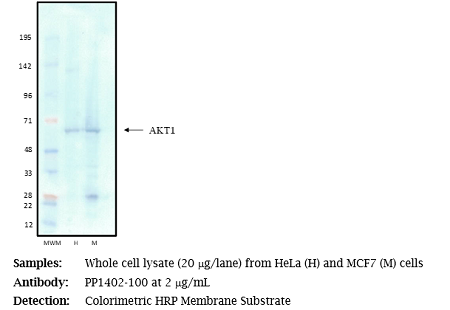
AKT1 Polyclonal Antibody
- Catalog Number:
- PP1402
- Availability:
- In stock
- Application:
- Western Blot
- Host:
- Rabbit
- 100% Homology:
- Acinonyx jubatus (cheetah), Acomys russatus (golden spiny mouse), Ailuropoda melanoleuca (giant panda), Apodemus sylvaticus (European woodmouse), Balaenoptera ricei (Rice's whale), Bison bison bison (American buffalo), Bos taurus (domestic cattle), Budorcas taxicolor (takin), Callithrix jacchus (white-tufted-ear marmoset), Callorhinus ursinus (northern fur seal), Canis lupus familiaris (dog), Capra hircus (goat), Carassius auratus (goldfish), Cavia porcellus (domestic guinea pig), Cebus imitator (Panamanian white-faced capuchin), Ceratotherium simum simum (southern white rhinoceros), Cricetulus griseus (Chinese hamster), Dama dama (fallow deer), Danio rerio (zebrafish), Delphinus delphis (saddleback dolphin), Dissostichus eleginoides (Patagonian toothfish), Equus caballus (horse), Equus quagga (plains zebra), Erinaceus europaeus (western European hedgehog), Eschrichtius robustus (grey whale), Eubalaena glacialis (North Atlantic right whale), Euleptes europaea (tarantolino), Eumetopias jubatus (Steller sea lion), Felis catus (domestic cat), Fukomys damarensis (Damara mole-rat), Gorilla gorilla gorilla (western lowland gorilla), Halichoerus grypus (gray seal), Heterocephalus glaber (naked mole-rat), Homo sapiens (human), Hylobates moloch (silvery gibbon), Ictidomys tridecemlineatus (thirteen-lined ground squirrel), Labeo rohita (rohu), Leptonychotes weddellii (Weddell seal), Lepus europaeus (European hare), Lynx canadensis (Canada lynx), Lynx pardinus (Spanish lynx), Lynx rufus (bobcat), Macaca fascicularis (crab-eating macaque), Mesocricetus auratus (golden hamster), Mesoplodon densirostris (Blainville's beaked whale), Microtus ochrogaster (prairie vole), Mirounga angustirostris (Northern elephant seal), Moschus berezovskii (Chinese forest musk deer), Mus musculus (house mouse), Mustela lutreola (European mink), Mustela putorius furo (domestic ferret), Nannospalax galili (Upper Galilee mountains blind mole rat), Neogale vison (American mink), Neomonachus schauinslandi (Hawaiian monk seal), Neophocaena asiaeorientalis asiaeorientalis (Yangtze finless porpoise), Nomascus leucogenys (northern white-cheeked gibbon), Ochotona princeps (American pika), Oncorhynchus mykiss (rainbow trout), Oncorhynchus nerka (sockeye salmon), Orcinus orca (killer whale), Oryctolagus cuniculus (rabbit), Ovis aries (sheep), Pan paniscus (pygmy chimpanzee), Pan troglodytes (chimpanzee), Panthera leo (lion), Panthera onca (jaguar), Panthera tigris (tiger), Panthera uncia (snow leopard), Perognathus longimembris pacificus (Pacific pocket mouse), Phacochoerus africanus (Common warthog), Phoca vitulina (harbor seal), Phocoena sinus (vaquita), Phyllostomus hastatus (greater spear-nosed bat), Physeter catodon (sperm whale), Pimephales promelas (fathead minnow), Plecturocebus cupreus (coppery titi), Pongo abelii (Sumatran orangutan), Pongo pygmaeus (Bornean orangutan), Rattus norvegicus (Norway rat), Rhinolophus ferrumequinum (greater horseshoe bat), Rousettus aegyptiacus (Egyptian rousette), Saccopteryx bilineata (greater sac-winged bat), Saccopteryx leptura (lesser sac-winged bat), Salmo salar (Atlantic salmon), Sciurus carolinensis (gray squirrel), Scophthalmus maximus (turbot), Solea senegalensis (Senegalese sole), Sorex araneus (European shrew), Suncus etruscus (white-toothed pygmy shrew), Sus scrofa (pig), Talpa occidentalis (Iberian mole), Tursiops truncatus (common bottlenose dolphin), Ursus arctos (brown bear), Vulpes vulpes (red fox), Zalophus californianus (California sea lion)
- Label:
- Unconjugated
 Powered by Bioz
 - The AKT1 polyclonal antibody is unlabeled and has been qualified for use in Western Blot. It was made using a peptide with the sequence DSERRPHFPQFSYSASGTAK.It is known to recognize AKT1 in over 100 species. For research use only.
| Storage Conditions | 2°C to 8°C |
| Purification | Antigen-affinity |
| Country Of Origin | USA |
AKT1 (AKT Serine/Threonine Kinase 1, also known as Protein Kinase B alpha, PKBα) is a highly conserved serine/threonine protein kinase that functions as a central regulator of cell survival, growth, metabolism, and intracellular signaling across a wide range of species. AKT1 is a member of the AKT/PKB kinase family, which includes AKT1, AKT2, and AKT3, key components of the phosphoinositide 3-kinase (PI3K) signaling pathway. Activation of AKT1 occurs when PI3K-generated phosphatidylinositol (3,4,5)-trisphosphate (PIP3) recruits AKT to the plasma membrane, where it is phosphorylated by kinases such as PDK1 and mTORC2. Once activated, AKT1 phosphorylates numerous downstream substrates that regulate cell proliferation, apoptosis inhibition, glucose metabolism, protein synthesis, and cellular growth. Through these actions, AKT1 integrates signals from growth factors, cytokines, hormones, and receptor-mediated pathways, influencing processes such as development, immune cell activation, and tissue homeostasis. Because the PI3K–AKT signaling pathway is critical for maintaining normal cellular function, dysregulation of AKT1 activity is associated with cancer, metabolic disorders, cardiovascular disease, and immune dysregulation in many organisms. Due to its central role in cellular signaling and its strong evolutionary conservation, AKT1 is widely studied in cell biology, immunology, developmental biology, and disease research across diverse species.
Citations
100 ug
Price: $400.00