Slide 1 of 1 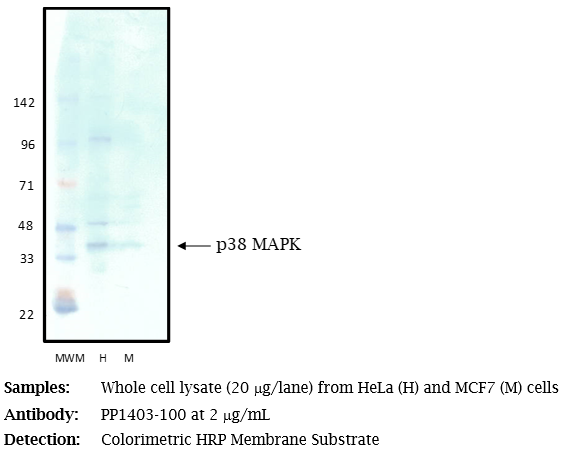
p38 MAPK Polyclonal Antibody
- Catalog Number:
- PP1403
- Availability:
- In stock
- Application:
- Western Blot
- Host:
- Rabbit
- Label:
- Unconjugated
 Powered by Bioz
 - The p38 MAPK polyclonal antibody is unlabeled and has been qualified for use in Western Blot. It was made using a peptide with the sequence AYFAQYHDPDDEPVADPYDC.It is known to recognize p38 MAPK in over 100 species. For research use only.
| Storage Conditions | 2°C to 8°C |
| Purification | Antigen-affinity |
| Country Of Origin | USA |
p38 Mitogen-Activated Protein Kinase (p38 MAPK) is a serine/threonine protein kinase that plays a critical role in regulating cellular responses to stress, inflammation, and immune signaling. p38 MAPK is a member of the MAP kinase family and is activated by upstream kinases such as MKK3 and MKK6 in response to environmental stressors, inflammatory cytokines, ultraviolet radiation, and microbial infection. Upon activation, p38 MAPK phosphorylates a variety of downstream substrates, including transcription factors, protein kinases, and regulatory proteins, leading to changes in gene expression that control inflammatory mediator production, cell differentiation, apoptosis, and cell cycle regulation. p38 MAPK signaling is particularly important in immune cells, where it regulates the production of proinflammatory cytokines such as TNF-α, IL-1β, and IL-6 and contributes to innate and adaptive immune responses. In cell culture, p38 MAPK pathways are commonly studied using recombinant proteins, kinase assays, and signaling models to investigate mechanisms of stress response, inflammatory signaling, and signal transduction. Due to its central role in inflammation and cellular stress responses, p38 MAPK has been extensively studied in biomedical research, particularly in models of inflammatory diseases, cancer, and metabolic disorders.
Citations
100 ug
Price: $400.00