Slide 1 of 1 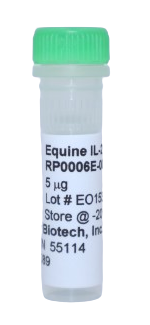
Equine IL-2 Recombinant Protein
- Catalog Number:
- RP0006E
- Availability:
- In stock
- Application:
- Cell Culture, Control, ELISA, ELISpot Control, Western Blot Control
- 100% Homology:
- Equus asinus (ass), Equus caballus (horse), Equus przewalskii (Przewalski's horse), Equus quagga (Plains zebra)
 Powered by Bioz
 - Equine IL-2 (catalog RP0006E) is a yeast-derived cytokine supplied lyophilized without carrier protein in 10% trehalose; it has no affinity tags and is naturally endotoxin-free, and should be reconstituted in sterile PBS containing at least 0.1% carrier protein. The protein is ~14.9 kDa, 129 amino acids long (full sequence provided), and >98% pure by SDS-PAGE, with 100% amino-acid homology across several equid species: horse, donkey, Przewalski's horse, and Plains zebra. Store at -20°C (stable up to twelve months from date of receipt; working aliquots with carrier protein stable ~3 months) and avoid repeated freeze/thaw cycles. Product origin is the USA. Kingfisher Biotech products are supplied for research applications and are not intended for medicinal, diagnostic, or therapeutic use. It is commonly used in immunology and cell-biology research to study T-cell proliferation and activation, NK-cell function and cytokine signaling; typical experimental uses include cell-culture stimulation and dosing studies, ELISA and neutralization assays, flow-cytometry controls, and antibody generation/validation.
| Amino Acid Sequence | APTSSSKRET QQQLKQLQMD LKLLLEGVNN NKNPKLSKML TFKINMPKKA TELKHLQCLE EELKPLEEML KNFLSKDIKE LMSNINVTVL GLKGSETRFT CEYDDETGTI VEFLNKWITF CQSIFSTMT (129) |
| Endotoxin | Naturally endotoxin-free |
| Form | Lyophilized |
| Storage Conditions | -20°C |
| Molecular Weight | 14.9 kDa |
| Purity | >98% as visualized by SDS-PAGE analysis. |
| Expression System | Yeast |
| Form | Lyophilized |
| Country Of Origin | USA |
Equine IL-2 (Interleukin-2) is a central T cell–derived cytokine that regulates lymphocyte proliferation, differentiation, and immune homeostasis in horses (Equus caballus). IL-2 is produced primarily by activated CD4⁺ and CD8⁺ T lymphocytes following antigen recognition and costimulatory signaling, and it functions through the IL-2 receptor complex (IL-2Rα/CD25, IL-2Rβ, and the common γ chain) to promote clonal expansion of antigen-specific T cells, enhance cytotoxic T lymphocyte and natural killer (NK) cell activity, and support development and maintenance of regulatory T cells (Tregs). In healthy horses, basal IL-2 expression is generally low but increases during infection, vaccination, and immune stimulation. Altered IL-2 responses have been associated with equine herpesvirus (EHV) infection, equine influenza, strangles (Streptococcus equi), equine infectious anemia virus (EIAV), and immune-mediated inflammatory diseases. Horses serve as important natural models for viral respiratory disease, chronic inflammatory airway disease (equine asthma), and lentiviral infection (EIAV as a model for HIV). In veterinary and comparative medicine research, equine IL-2 is widely used as a biomarker of T cell activation and cell-mediated immunity and is studied to evaluate vaccine efficacy, host–pathogen interactions, and immune regulation in equine health.
Citations
Please choose a size to see price
RELATED MEDIA

