Slide 1 of 1 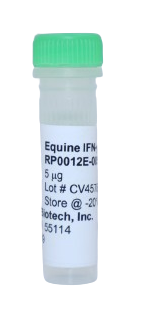
Equine IFN gamma Recombinant Protein
- Catalog Number:
- RP0012E
- Availability:
- In stock
- Application:
- Cell Culture, Control, ELISA, ELISpot Control, Western Blot Control
- 100% Homology:
- Equus caballus (horse)
 Powered by Bioz
 - Equine IFN-γ (catalog RP0012E) is a yeast-derived cytokine supplied lyophilized without carrier protein in 10% trehalose and should be reconstituted in sterile PBS containing at least 0.1% carrier protein. The protein is ~17.1 kDa, 146 amino acids long (full sequence provided), and >98% pure by SDS-PAGE, with 100% amino-acid homology to horse. Store at -20°C (stable up to twelve months from date of receipt; working aliquots with carrier protein stable ~3 months) and avoid repeated freeze/thaw cycles. Product origin is the USA. Kingfisher Biotech products are supplied for research applications and are not intended for medicinal, diagnostic, or therapeutic use. It is commonly used in immunology and cell-biology research to study interferon-γ signaling, macrophage activation, Th1 immune responses, antigen presentation, and antiviral/immunoregulatory functions; typical experimental uses include cell-culture stimulation and dosing studies, ELISA and neutralization assays, flow-cytometry controls, and antibody generation/validation.
| Amino Acid Sequence | YYCQAAFFKE IENLKEYFNA SNPDVGDGGP LFLDILKNWK EDSDKKIIQS QIVSFYFKLF ENLKDNQVIQ KSMDTIKEDL FAKFFNSSTS KLEDFQKLIQ IPVNDLKVQR KAISELIKVM NDLSPKANLR KRKRSQNPFR GRRALQ (146) |
| Endotoxin | Naturally endotoxin-free |
| Form | Lyophilized |
| Storage Conditions | -20°C |
| Molecular Weight | 17.1 kDa |
| Purity | >98% as visualized by SDS-PAGE analysis. |
| Expression System | Yeast |
| Form | Lyophilized |
| Country Of Origin | USA |
Equine Interferon-γ (IFN-γ) is a type II interferon cytokine that plays a central role in cell-mediated immunity and regulation of antimicrobial responses in horses (Equus caballus). IFN-γ is primarily produced by activated T helper 1 (Th1) lymphocytes, cytotoxic T cells, and natural killer (NK) cells following stimulation by intracellular pathogens or inflammatory cytokines. Equine IFN-γ binds to the interferon-γ receptor (IFNGR) expressed on many immune and non-immune cells, activating intracellular signaling through the JAK–STAT pathway, particularly STAT1, which induces transcription of interferon-stimulated genes involved in antimicrobial defense, antigen presentation, and immune regulation. In horses, IFN-γ is critical for macrophage activation, enhanced antigen presentation via MHC molecules, and control of intracellular pathogens. In equine health, IFN-γ contributes to immune responses against infectious diseases such as equine herpesvirus and Rhodococcus equi infections. Horses are also used as animal models for respiratory and intracellular bacterial infections, and IFN-γ–mediated immune responses have been studied in foal models of Rhodococcus equi pneumonia, where IFN-γ–driven macrophage activation is important for controlling intracellular bacterial replication, providing insights relevant to both equine infectious disease and comparative studies of pulmonary immunity.
Citations
Please choose a size to see price
RELATED MEDIA

