Slide 1 of 1 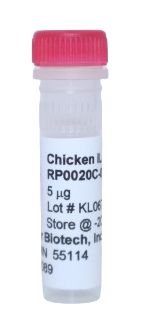
Multi-species (Chicken, Duck) IL-18 Recombinant Protein
- Catalog Number:
- RP0020C
- Availability:
- In stock
- Application:
- Cell Culture, Control, ELISA, ELISpot Control, Western Blot Control
- 100% Homology:
- Anas platyrhynchos (mallard), Ara macao (Scarlet macaw), Columba livia (rock pigeon), Coturnix coturnix (common quail), Gallus gallus (chicken), Pica pica (Eurasian magpie)
 Powered by Bioz
 - Chicken/Mallard IL-18 (catalog RP0020C) is a yeast-derived cytokine supplied lyophilized without carrier protein in 10% trehalose; it has no affinity tags and is naturally endotoxin-free, and should be reconstituted in sterile PBS that contains at least 0.1% carrier protein. The protein is ~19.5 kDa, 169 amino acids long (full sequence provided), and >98% pure by SDS-PAGE, with 100% amino-acid homology across several avian species: chicken, mallard, scarlet macaw, rock pigeon, common quail, and Eurasian magpie. Store at -20°C (stable up to twelve months from date of receipt; working aliquots with carrier protein stable ~3 months) and avoid repeated freeze/thaw cycles. Product origin is the USA. Kingfisher Biotech products are supplied for research applications and are not intended for medicinal, diagnostic, or therapeutic use. It is commonly used in immunology and cell-biology research to study IL-18 signaling, induction of IFN-γ and Th1 responses, NK-cell and T-cell activation, and inflammatory/inflammasome biology; typical experimental uses include cell-culture stimulation and dosing studies, IFN-γ induction and cytokine assays, ELISA and neutralization assays, receptor-binding and signaling studies, flow-cytometry controls, and antibody generation/validation.
| Amino Acid Sequence | AFCKDKTIKR FFRNVNSQLL VVRPDLNVAA FEDVTDQEVK SGSGMYFDIH CYKTTAPSAG MPVAFSVQVE DKSYYMCCEK EHGKMVVRFR EGEVPKDIPG ESNIIFFKKT FTSCSSKAFK FEYSLEQGMF LAFEEEDSLR KLILKKLPRE DEVDETTKFV TSHNERHNL (169) |
| Endotoxin | Naturally endotoxin-free |
| Form | Lyophilized |
| Storage Conditions | -20°C |
| Molecular Weight | 19.5 kDa |
| Purity | >98% as visualized by SDS-PAGE analysis. |
| Expression System | Yeast |
| Form | Lyophilized |
| Country Of Origin | USA |
Chicken IL-18 (Interleukin-18) is a pro-inflammatory cytokine belonging to the IL-1 family that plays an important role in innate and adaptive immune responses in chickens (Gallus gallus). IL-18 is produced primarily by macrophages, dendritic cells, and epithelial cells as an inactive precursor that requires cleavage by caspase-1 following inflammasome activation to become biologically active. Once activated, IL-18 stimulates production of interferon-γ (IFN-γ) by T cells and natural killer (NK)-like cells, thereby promoting Th1-type immune responses and enhancing cell-mediated immunity against intracellular pathogens. In healthy chickens, basal IL-18 expression is generally low, but levels increase during viral, bacterial, and parasitic infections, including Marek’s disease virus (MDV), infectious bursal disease virus (IBDV), Salmonella spp., and Eimeria spp. IL-18 has also been studied as a molecular adjuvant to enhance vaccine-induced cellular immunity in poultry. In avian immunology and poultry research, chicken IL-18 serves as a biomarker of inflammasome activation and Th1-skewed immune responses, providing insight into host–pathogen interactions, vaccine efficacy, and immune regulation in commercial and experimental poultry systems.
Citations
Please choose a size to see price
RELATED MEDIA

