Slide 1 of 1 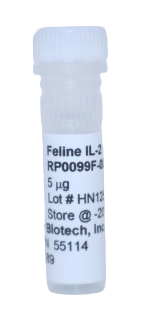
Feline IL-2 Recombinant Protein
- Catalog Number:
- RP0099F
- Availability:
- In stock
- Application:
- Cell Culture, Control, ELISA, ELISpot Control, Western Blot Control
- 100% Homology:
- Felis catus (domestic cat)
 Powered by Bioz
 - Feline IL-2 (catalog RP0099F) is a yeast-derived cytokine supplied lyophilized without carrier protein in 10% trehalose; it has no affinity tags and is naturally endotoxin-free, and should be reconstituted in sterile PBS that contains at least 0.1% carrier protein. The protein is ~15.4 kDa, 134 amino acids long (full sequence provided), and >98% pure by SDS-PAGE, with 100% amino-acid homology to domestic cat. Store at -20°C (stable up to twelve months from date of receipt; working aliquots with carrier protein stable at least 3 months) and avoid repeated freeze/thaw cycles. Product origin is the USA. Kingfisher Biotech products are supplied for research applications and are not intended for medicinal, diagnostic, or therapeutic use. It is commonly used in immunology and cell-biology research to study T-cell proliferation and activation, NK-cell function and cytokine signaling; typical experimental uses include cell-culture stimulation and dosing studies, proliferation/cytotoxicity assays, ELISA and neutralization assays, flow-cytometry and Western blot controls, and antibody generation/validation.
| Amino Acid Sequence | APASSSTKET QQQLEQLLLD LRLLLNGVNN PENPKLSRML TFKFYVPKKA TELTHLQCLV EELKPLEEVL YLAQSKNFHL NHIKELMSNI NVTVLKLKGS ETRFTCNYDD ETATIVEFLN KWITFCQSIF STLT (134) |
| Endotoxin | Naturally endotoxin-free |
| Form | Lyophilized |
| Storage Conditions | -20°C |
| Molecular Weight | 15.4 kDa |
| Purity | >98% as visualized by SDS-PAGE analysis. |
| Expression System | Yeast |
| Form | Lyophilized |
| Country Of Origin | USA |
Feline IL-2 (Interleukin-2) is a central T cell–derived cytokine that regulates lymphocyte proliferation, differentiation, and immune homeostasis in cats (Felis catus). IL-2 is produced primarily by activated CD4⁺ and CD8⁺ T lymphocytes following antigen recognition and costimulatory signaling, and it functions through the IL-2 receptor complex (IL-2Rα/CD25, IL-2Rβ, and the common γ chain) to promote clonal expansion of antigen-specific T cells, enhance cytotoxic T lymphocyte and natural killer (NK) cell activity, and support development and maintenance of regulatory T cells (Tregs). In healthy cats, basal IL-2 expression is typically low but increases rapidly during infection, vaccination, or immune stimulation. Altered IL-2 production has been associated with feline immunodeficiency virus (FIV) infection, feline leukemia virus (FeLV) infection, feline infectious peritonitis (FIP), chronic inflammatory conditions, and immune-mediated diseases. Cats serve as important natural and translational animal models for human diseases including HIV/AIDS (FIV model), lymphoma and other cancers, asthma, and certain neuroinflammatory and infectious diseases. In veterinary and comparative medicine research, feline IL-2 is studied as a biomarker of T cell activation and adaptive immune competence and has been investigated as an immunotherapeutic agent in oncology and chronic viral infection settings.
Citations
Please choose a size to see price
RELATED MEDIA
