Slide 1 of 1 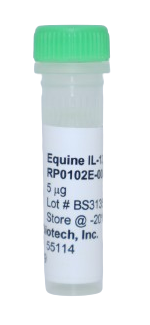
Equine IL-13 Recombinant Protein
- Catalog Number:
- RP0102E
- Availability:
- In stock
- Application:
- Cell Culture, Control, ELISA, ELISpot Control, Western Blot Control
- 100% Homology:
- Equus asinus (ass), Equus caballus (horse), Equus przewalskii (Przewalski's horse), Equus quagga (Plains Zebra)
 Powered by Bioz
 - Equine IL-13 (catalog RP0102E) is a yeast-derived cytokine supplied lyophilized without carrier protein in 10% trehalose; it has no affinity tags and is naturally endotoxin-free, and should be reconstituted in sterile PBS that contains at least 0.1% carrier protein. The protein is ~12.6 kDa, 115 amino acids long (full sequence provided), and >98% pure by SDS-PAGE, with 100% amino-acid homology across several equid species: horse, donkey (ass), Przewalski's horse, and Plains zebra. Store at -20°C (stable up to twelve months from date of receipt; working aliquots with carrier protein stable ~3 months) and avoid repeated freeze/thaw cycles. Product origin is the USA. Kingfisher Biotech products are supplied for research applications and are not intended for medicinal, diagnostic, or therapeutic use. It is commonly used in immunology and cell-biology research to study IL-13 signaling and Th2 responses, mucus production and airway hyperresponsiveness, alternative (M2) macrophage activation, fibrosis and epithelial cell biology, and to support eosinophil and B-cell functions (including IgE class switching); typical experimental uses include cell-culture stimulation and dosing studies, ELISA and neutralization assays, flow-cytometry and Western blot controls, cytokine signaling assays, and antibody generation/validation.
| Amino Acid Sequence | SPAPLPSSMA LKELIKELVN ITQNQAPLCN GSMVWSVNLT ADTYCRALES LSNVSTCSAI QNTRKMLTKL CPHQLSAGQV SSERARDTKI EVIVLVKDLL KNLRKIFHGG KHVDA (115) |
| Endotoxin | Naturally endotoxin-free |
| Form | Lyophilized |
| Storage Conditions | -20°C |
| Molecular Weight | 12.6kDa |
| Purity | >98% as visualized by SDS-PAGE analysis. |
| Expression System | Yeast |
| Form | Lyophilized |
| Country Of Origin | USA |
Equine Interleukin-13 (IL-13) is a Th2-associated cytokine produced primarily by activated CD4⁺ T helper 2 (Th2) cells and other type 2 immune populations in horses (Equus caballus), where it plays a central role in regulating allergic inflammation, mucosal immunity, and tissue remodeling. IL-13 signals through receptor complexes composed of IL-13Rα1 and IL-4Rα, activating JAK/STAT6 pathways that promote alternative macrophage activation, mucus production, IgE-associated immune responses, and modulation of pro-inflammatory cytokine signaling. In equine health, IL-13 is particularly relevant in allergic and inflammatory conditions such as equine asthma (recurrent airway obstruction), insect bite hypersensitivity, parasitic infections, and certain gastrointestinal inflammatory disorders, where Th2 polarization contributes to eosinophilic infiltration, airway hyperreactivity, and tissue remodeling. While IL-13 supports parasite defense and tissue repair, excessive or chronic IL-13 signaling may contribute to airway fibrosis and persistent inflammation. As a biomarker of type 2 immune activation, equine IL-13 is important in studies of allergic disease pathogenesis, vaccine responses, and immune regulation. In translational research, horses serve as valuable large-animal models for human asthma and allergic airway disease, and characterization of equine IL-13 supports comparative investigations into Th2-mediated inflammation and development of targeted anti-cytokine therapies relevant to both equine and human medicine.
Citations
Please choose a size to see price
RELATED MEDIA
