Slide 1 of 1 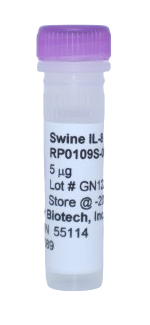
Swine IL-8 Recombinant Protein
- Catalog Number:
- RP0109S
- Availability:
- In stock
- Application:
- Cell Culture, Control, ELISA, ELISpot Control, Western Blot Control
- 100% Homology:
- Phacochoerus africanus (Common warthog), Sus scrofa (pig)
 Powered by Bioz
 - Swine IL-8 (alias CXCL8, interleukin-8) (catalog RP0109S) is a yeast-derived chemokine supplied lyophilized without carrier protein in 10% trehalose; it has no affinity tags and is naturally endotoxin-free, and should be reconstituted in sterile PBS that contains at least 0.1% carrier protein. The protein is ~9.1 kDa, 78 amino acids long (full sequence provided), and >98% pure by SDS-PAGE, with 100% amino-acid homology to pig and common warthog. Store at -20°C (stable up to twelve months from date of receipt; working aliquots with carrier protein stable ~3 months) and avoid repeated freeze/thaw cycles. Product origin is the USA. Kingfisher Biotech products are supplied for research applications and are not intended for medicinal, diagnostic, or therapeutic use. It is commonly used to study chemokine signaling, neutrophil and leukocyte chemoattraction/activation, and inflammation; typical experimental uses include chemotaxis and cell-migration assays, cell-culture stimulation and dosing studies, ELISA and neutralization assays, receptor-binding and signaling studies, flow-cytometry and Western blot controls, and antibody generation/validation.
| Amino Acid Sequence | ARVSAELRCQ CINTHSTPFH PKFIKELRVI ESGPHCENSE IIVKLVNGKE VCLDPKEKWV QKVVQIFLKR TEKQQQQQ (78) |
| Endotoxin | Naturally endotoxin-free |
| Form | Lyophilized |
| Storage Conditions | -20°C |
| Molecular Weight | 9.1kDa |
| Purity | >98% as visualized by SDS-PAGE analysis. |
| Expression System | Yeast |
| Form | Lyophilized |
| Country Of Origin | USA |
Swine Interleukin-8 (IL-8), also known as CXCL8, is a potent pro-inflammatory chemokine that plays a central role in innate immune responses in pigs (Sus scrofa domesticus) by mediating neutrophil chemotaxis, activation, and migration to sites of infection or tissue injury. Produced by macrophages, respiratory and intestinal epithelial cells, endothelial cells, and other immune cells in response to microbial products and inflammatory cytokines, swine IL-8 signals primarily through CXCR1 and CXCR2 receptors to promote rapid neutrophil recruitment and amplification of inflammatory responses. Elevated IL-8 expression is observed in economically significant diseases such as porcine reproductive and respiratory syndrome (PRRS), swine influenza, Mycoplasma hyopneumoniae infection, Actinobacillus pleuropneumoniae pneumonia, enteric infections, and bacterial sepsis, where excessive neutrophilic inflammation can contribute to lung injury, reduced growth performance, and systemic pathology. As a biomarker, IL-8 is widely used to assess immune activation, vaccine response, and disease severity in swine production systems. In translational research, pigs serve as valuable large-animal models for human respiratory disease, sepsis, trauma, and inflammatory disorders due to their physiological and immunological similarities to humans; thus, characterization of swine IL-8 supports studies of neutrophil-driven immunopathology, cytokine network regulation, and development of targeted anti-inflammatory and immunomodulatory therapies relevant to both veterinary and human medicine.
Citations
Please choose a size to see price
RELATED MEDIA
