Slide 1 of 1 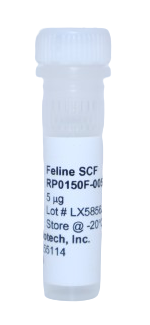
Feline SCF (Stem Cell Factor) Recombinant Protein
- Catalog Number:
- RP0150F
- Availability:
- In stock
- Application:
- Cell Culture, Control, ELISA, ELISpot Control, Western Blot Control
- 100% Homology:
- Acinonyx jubatus (cheetah), Felis catus (domestic cat), Leopardus geoffroyi (Geoffroy's cat), Lynx rufus (bobcat), Neofelis nebulosa (Clouded leopard), Panthera leo (lion), Panthera onca (jaguar), Panthera pardus (leopard), Panthera tigris (tiger), Panthera tigris altaica (Amur tiger), Prionailurus bengalensis (leopard cat), Prionailurus viverrinus (fishing cat)
 Powered by Bioz
 - Feline SCF (catalog RP0150F) is a yeast-derived growth factor supplied lyophilized without carrier protein in 10% trehalose; it has no affinity tags and is naturally endotoxin-free, and should be reconstituted in sterile PBS that contains at least 0.1% carrier protein. The protein is ~27.9 kDa, 248 amino acids long (full sequence provided), and >98% pure by SDS-PAGE, with 100% amino-acid homology across multiple felids (domestic cat, cheetah, bobcat, lion, leopard, Amur tiger, leopard cat, fishing cat, tiger, Geoffroy's cat, clouded leopard, and jaguar). Store at -20°C (stable up to twelve months from date of receipt; working aliquots with carrier protein stable at least 3 months) and avoid repeated freeze/thaw cycles. Product origin is the USA. Kingfisher Biotech products are supplied for research applications and are not intended for medicinal, diagnostic, or therapeutic use. It is commonly used to study SCF/c-Kit signaling, hematopoietic stem and progenitor cell survival and proliferation, mast-cell growth and differentiation, and hematopoiesis; typical experimental uses include cell-culture stimulation and dosing studies, proliferation and colony-forming assays, mast-cell assays, receptor-binding and signaling studies, ELISA and neutralization assays, flow-cytometry and Western blot controls, and antibody generation/validation.
| Amino Acid Sequence | GLCRNRVTDD VKDVTKLVAN LPKDYKIALK YVPGMDVLPS HCWISVMVEQ LSVSLTDLLD KFSNISEGLS NYSIIDKLVK IVDDLVECVE GHSSENVKKS SKSPEPRLFT PEEFFRIFNR SIDAFKDLEM VASKTSECVV SSTLSPEKDS RVSVTKPFML PPVAASSLRN DSSSSNRKAT NPIEDSSIQW AVMALPACFS LVIGFAFGAF YWKKKQPNLT RTVENIQINE EDNEISMLQE KEREFQEV (248) |
| Endotoxin | Naturally endotoxin-free |
| Form | Lyophilized |
| Storage Conditions | -20°C |
| Molecular Weight | 27.9 kDa |
| Purity | >98% as visualized by SDS-PAGE analysis. |
| Expression System | Yeast |
| Form | Lyophilized |
| Country Of Origin | USA |
Feline Stem Cell Factor (SCF) (also known as KIT ligand, KITLG, mast cell growth factor, or steel factor) is a cytokine and growth factor that plays a key role in hematopoiesis, stem cell maintenance, and immune cell development in cats (Felis catus). SCF belongs to a small group of hematopoietic growth factors that regulate survival and proliferation of stem and progenitor cells. It functions by binding to its receptor c-Kit (CD117), a receptor tyrosine kinase expressed on hematopoietic stem cells, mast cells, melanocytes, and germ cells, activating intracellular signaling pathways including PI3K/AKT, MAPK, and JAK/STAT that regulate cell survival, proliferation, and differentiation. In cats, SCF is produced by stromal cells, fibroblasts, endothelial cells, and epithelial cells and exists in both membrane-bound and soluble forms, which provide local and systemic regulation of c-Kit–expressing cells. SCF is particularly important for mast cell development and function, making it relevant to feline diseases such as mast cell tumors, where dysregulated c-Kit signaling contributes to abnormal mast cell proliferation. SCF also plays roles in hematopoietic stem cell maintenance, pigmentation biology, and reproductive cell development. Because of its central role in stem cell biology and c-Kit–mediated signaling, feline SCF is studied in research on hematopoiesis, mast cell disease, oncology, and regenerative medicine, contributing to understanding of growth factor regulation and cellular development in cats.
Citations
Please choose a size to see price
RELATED MEDIA
