Slide 1 of 1 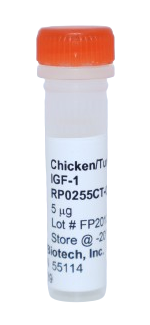
Multi-species (Chicken, Duck, Turkey, Zebra Finch) IGF-1 Recombinant Protein
- Catalog Number:
- RP0255CT
- Availability:
- In stock
- Application:
- Cell Culture, Control, ELISA, ELISpot Control, Western Blot Control
- 100% Homology:
- Acanthisitta chloris (rifleman), Alligator mississippiensis (American alligator), Alligator sinensis (Chinese alligator), Amazona aestiva (blue-fronted amazon), Anas platyrhynchos (mallard), Anser anser (domestic goose), Apaloderma vittatum (bar-tailed trogon), Aptenodytes forsteri (emperor penguin), Balearica regulorum gibbericeps (East African grey crowned-crane), Cariama cristata (red-legged seriema), Chelydra serpentina (common snapping turtle), Chrysemys picta bellii (western painted turtle), Colius striatus (speckled mousebird), Coturnix japonica (Japanese quail), Crocodylus porosus (Australian saltwater crocodile), Ficedula albicollis (collared flycatcher), Gallus gallus (chicken), Gavialis gangeticus (Gharial), Geospiza fortis (medium ground-finch), Manacus vitellinus (golden-collared manakin), Meleagris gallopavo (turkey), Melopsittacus undulatus (budgerigar), Numida meleagris (helmeted guineafowl), Pelecanus crispus (Dalmatian pelican), Serinus canaria (common canary), Taeniopygia guttata (zebra finch), Tauraco erythrolophus (red-crested turaco), Tyto alba (barn owl)
 Powered by Bioz
 - IGF-1 (multi-species: chicken, duck, turkey, zebra finch) (catalog RP0255CT) is a yeast-derived growth factor supplied lyophilized without carrier protein in 10% trehalose; it has no affinity tags and is naturally endotoxin-free, and should be reconstituted in sterile PBS that contains at least 0.1% carrier protein. The protein is ~7.7 kDa, 70 amino acids long (full sequence provided), and >98% pure by SDS-PAGE, with 100% amino-acid homology across multiple avian species (including chicken, mallard/duck, turkey and zebra finch). Store at -20°C (stable up to twelve months from date of receipt; working aliquots with carrier protein stable ~3 months) and avoid repeated freeze/thaw cycles. Product origin is the USA. Kingfisher Biotech products are supplied for research applications and are not intended for medicinal, diagnostic, or therapeutic use. It is commonly used to study IGF-1 signaling and growth-factor biology (cell proliferation, metabolic signaling and receptor interactions); typical experimental uses include cell-culture stimulation and dosing studies, proliferation/differentiation assays, receptor-binding and signaling studies, ELISA and neutralization assays, and use as flow-cytometry and Western blot controls or for antibody generation/validation.
| Amino Acid Sequence | GPETLCGAEL VDALQFVCGD RGFYFSKPTG YGSSSRRLHH KGIVDECCFQ SCDLRRLEMY CAPIKPPKSA (70) |
| Endotoxin | Naturally endotoxin-free |
| Form | Lyophilized |
| Storage Conditions | -20°C |
| Molecular Weight | 7.7 kDa |
| Purity | >98% as visualized by SDS-PAGE analysis. |
| Expression System | Yeast |
| Form | Lyophilized |
| Country Of Origin | USA |
Avian Insulin-like Growth Factor 1 (IGF-1) is a peptide growth factor that plays a central role in regulating growth, development, tissue maintenance, and metabolic processes in birds including chicken (Gallus gallus), duck (Anas platyrhynchos), turkey (Meleagris gallopavo), and zebra finch (Taeniopygia guttata). The IGF-1 protein is identical at the amino acid level among these species, reflecting strong evolutionary conservation and its essential biological functions in avian physiology. IGF-1 is produced primarily in the liver in response to growth hormone stimulation and circulates in the bloodstream bound to insulin-like growth factor binding proteins (IGFBPs), which regulate its stability, transport, and tissue availability. It is also expressed locally in multiple tissues including muscle, bone, and reproductive organs, where it functions through autocrine and paracrine signaling. Avian IGF-1 binds to the insulin-like growth factor 1 receptor (IGF1R), a transmembrane tyrosine kinase receptor that activates intracellular signaling pathways such as PI3K–AKT and MAPK, regulating cell proliferation, differentiation, survival, and protein synthesis. In these bird species, IGF-1 plays a critical role in somatic growth, skeletal development, and muscle accretion, and also contributes to regulation of metabolism, feather development, and reproductive physiology. Due to these functions, IGF-1 is widely studied in avian biology and agricultural research, where circulating IGF-1 levels are commonly used as a biomarker of growth rate, nutritional status, and endocrine regulation of growth in poultry and passerine models.
Citations
Please choose a size to see price
RELATED MEDIA
