Slide 1 of 1 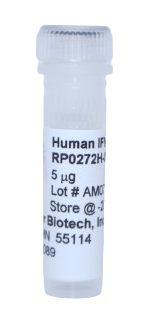
Human IFN gamma Recombinant Protein
- Catalog Number:
- RP0272H
- Availability:
- In stock
- Application:
- Cell Culture, Control, ELISA, ELISpot Control, Western Blot Control
- 100% Homology:
- Gorilla gorilla (western gorilla), Homo sapiens (human)
 Powered by Bioz
 - Human IFN-γ (catalog RP0272H) is a yeast-derived cytokine supplied lyophilized without carrier protein in 10% trehalose; it has no affinity tags and is naturally endotoxin-free, and should be reconstituted in sterile PBS that contains at least 0.1% carrier protein. The protein is ~16.8 kDa, 143 amino acids long (full sequence provided), and >98% pure by SDS-PAGE, with 100% amino-acid homology to human and western gorilla. Store at -20°C (stable up to twelve months from date of receipt; working aliquots with carrier protein stable ~3 months) and avoid repeated freeze/thaw cycles. Product origin is the USA. Kingfisher Biotech products are supplied for research applications and are not intended for medicinal, diagnostic, or therapeutic use. It is commonly used in immunology and cell-biology research to study interferon-γ signaling, macrophage activation, Th1 immune responses, antigen presentation and antiviral/immunoregulatory functions; typical experimental uses include cell-culture stimulation and dosing studies, ELISA and neutralization assays, receptor-binding and signaling studies, flow-cytometry and Western blot controls, and antibody generation/validation.
| Amino Acid Sequence | QDPYVKEAEN LKKYFNAGHS DVADNGTLFL GILKNWKEES DRKIMQSQIV SFYFKLFKNF KDDQSIQKSV ETIKEDMNVK FFNSNKKKRD DFEKLTNYSV TDLNVQRKAI HELIQVMAEL SPAAKTGKRK RSQMLFRGRR ASQ (143) |
| Endotoxin | Naturally endotoxin-free |
| Form | Lyophilized |
| Storage Conditions | -20°C |
| Molecular Weight | 16.8 kDa |
| Purity | >98% as visualized by SDS-PAGE analysis. |
| Expression System | Yeast |
| Form | Lyophilized |
| Country Of Origin | USA |
Human Interferon-γ (IFN-γ) is a type II interferon cytokine that plays a central role in cell-mediated immunity and regulation of antimicrobial and inflammatory responses in humans (Homo sapiens). IFN-γ is produced primarily by activated T helper 1 (Th1) cells, cytotoxic T lymphocytes, and natural killer (NK) cells following stimulation by intracellular pathogens or immune signaling molecules such as IL-12 and IL-18. Human IFN-γ binds to the interferon-γ receptor (IFNGR1/IFNGR2) expressed on many immune and non-immune cells, activating intracellular signaling through the JAK–STAT pathway, particularly STAT1, which induces expression of numerous interferon-stimulated genes involved in antigen presentation, macrophage activation, and antimicrobial defense. IFN-γ is critical for activation of macrophages, enhancement of MHC class I and II expression, and control of intracellular pathogens, especially mycobacteria, viruses, and certain parasites. In human health, IFN-γ is essential for immunity against diseases such as tuberculosis and viral infections, and defects in IFN-γ signaling can lead to increased susceptibility to mycobacterial disease. Human IFN-γ is also widely studied and used in clinical diagnostics and immunotherapy, including IFN-γ release assays (IGRAs) for detection of Mycobacterium tuberculosis infection and therapeutic use of recombinant IFN-γ in certain immune deficiency and infectious disease conditions.
Citations
Please choose a size to see price
RELATED MEDIA
