Slide 1 of 1 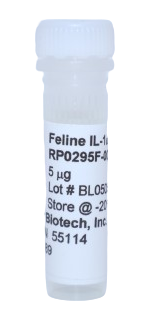
Feline IL-1 alpha Recombinant Protein
- Catalog Number:
- RP0295F
- Availability:
- In stock
- Application:
- Cell Culture, Control, ELISA, ELISpot Control, Western Blot Control
- 100% Homology:
- Felis catus (domestic cat)
 Powered by Bioz
 - Feline IL-1α (catalog RP0295F) is a yeast-derived cytokine supplied lyophilized without carrier protein in 10% trehalose; it has no affinity tags and is naturally endotoxin-free, and should be reconstituted in sterile PBS that contains at least 0.1% carrier protein. The protein is ~18.0 kDa, 158 amino acids long (full sequence provided), and >98% pure by SDS-PAGE, with 100% amino-acid homology to domestic cat. Store at -20°C (stable up to twelve months from date of receipt; working aliquots with carrier protein stable ~3 months) and avoid repeated freeze/thaw cycles. Product origin is the USA. It is commonly used to study IL-1α signaling, inflammation and innate immune responses; typical experimental uses include cell-culture stimulation and dosing studies, cytokine and inflammasome assays, ELISA and neutralization assays, receptor-binding and signaling studies, flow-cytometry and Western blot controls, and antibody generation/validation. Kingfisher Biotech products are supplied for research applications and are not intended for medicinal, diagnostic, or therapeutic use.
| Amino Acid Sequence | SVAPNFYSSE KYNYQKIIKS QFILNDNLSQ SVIRKAGGKY LAAAALQNLD DAVKFDMGAY TSKEDSKLPV TLRISKTRLF VSAQNEDEPV LLKEMPETPK TIRDETNLLF FWERHGSKNY FKSVAHPKLF IATQEEQLVH MARGLPSVTD FQILETQS (158) |
| Endotoxin | Naturally endotoxin-free |
| Form | Lyophilized |
| Storage Conditions | -20°C |
| Molecular Weight | 18.0 kDa |
| Purity | >98% as visualized by SDS-PAGE analysis. |
| Expression System | Yeast |
| Form | Lyophilized |
| Country Of Origin | USA |
Feline Interleukin-1 Alpha (IL-1α) is a pro-inflammatory cytokine belonging to the IL-1 family, which includes IL-1α, IL-1β, and the IL-1 receptor antagonist (IL-1Ra), and plays a central role in initiating and amplifying innate immune responses in cats (Felis catus). Unlike IL-1β, IL-1α is constitutively expressed in epithelial and other barrier tissues and can function as both a membrane-bound and intracellular alarmin released upon cell injury or necrosis. IL-1α signals through the IL-1 receptor type 1 (IL-1R1), activating NF-κB and MAPK pathways that drive leukocyte recruitment, fever, endothelial activation, and production of additional pro-inflammatory mediators. In feline health, IL-1α is particularly relevant in inflammatory skin diseases, chronic gingivostomatitis, inflammatory bowel disease, respiratory infections, and osteoarthritis, where it contributes to local tissue inflammation and immune cell infiltration. Dysregulated IL-1α signaling may exacerbate chronic inflammatory conditions and tissue damage. As both an early mediator of sterile inflammation and a biomarker of tissue injury, feline IL-1α is important in studies of mucosal immunity, chronic inflammatory disease, and host–pathogen interactions. In translational research, cats serve as valuable spontaneous models for human inflammatory and oral mucosal diseases, and characterization of feline IL-1α supports comparative investigations into cytokine-driven pathology and development of targeted anti-inflammatory therapies relevant to both veterinary and human medicine.
Citations
Please choose a size to see price
RELATED MEDIA
