Slide 1 of 1 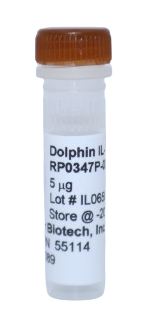
Dolphin IL-1 beta Recombinant Protein
- Catalog Number:
- RP0347P
- Availability:
- In stock
- Application:
- Cell Culture, Control, ELISA, ELISpot Control, Western Blot Control
- 100% Homology:
- Delphinus delphis (saddleback dolphin), Lagenorhynchus albirostris (white-beaked dolphin), Lagenorhynchus obliquidens (Pacific white-sided dolphin), Orcinus orca (killer whale), Tursiops truncatus (common bottlenose dolphin)
 Powered by Bioz
 - Dolphin IL-1β (catalog RP0347P) is a yeast-derived cytokine supplied lyophilized without carrier protein in 10% trehalose; it has no affinity tags and is naturally endotoxin-free, and should be reconstituted in sterile PBS that contains at least 0.1% carrier protein. The protein is ~17.5 kDa, 153 amino acids long (full sequence provided), and >98% pure by SDS-PAGE, with 100% amino-acid homology across several cetaceans (including common bottlenose, Pacific white-sided, killer whale, saddleback and white-beaked dolphins). Store at -20°C (stable up to twelve months from date of receipt; working aliquots with carrier protein stable ~3 months) and avoid repeated freeze/thaw cycles. Product origin is the USA. It is commonly used to study IL-1β signaling, inflammation, inflammasome/pyroptosis and innate immune responses; typical experimental uses include cell-culture stimulation and dosing studies, cytokine and inflammasome assays, ELISA and neutralization assays, receptor-binding and signaling studies, flow-cytometry and Western blot controls, and antibody generation/validation. Kingfisher Biotech products are supplied for research applications and are not intended for medicinal, diagnostic, or therapeutic use.
| Amino Acid Sequence | AAVQSLTCKL QDRDQKSLVL ASPCVLKALH LLARDMNREV VFCMSFVQGD ESNDKIPVAL GLKEKNLYLS CVMKGDRPIL QLEEVDPKTY PKWKMEKRFV FNKTEIKNSV EFESALYPNW YISTSQAEEK PIFLGRSKGG HDITDFTMEI ISP (153) |
| Endotoxin | Naturally endotoxin-free |
| Form | Lyophilized |
| Storage Conditions | -20°C |
| Molecular Weight | 17.5 kDa |
| Purity | >98% as visualized by SDS-PAGE analysis. |
| Expression System | Yeast |
| Form | Lyophilized |
| Country Of Origin | USA |
Dolphin Interleukin-1 Beta (IL-1β) is a potent pro-inflammatory cytokine produced primarily by activated macrophages and other innate immune cells in dolphins, particularly the bottlenose dolphin (Tursiops truncatus), in response to infection, tissue injury, or environmental stressors. Synthesized as an inactive precursor (pro–IL-1β), it requires cleavage by caspase-1 within the inflammasome complex to become biologically active, after which it signals through the IL-1 receptor (IL-1R1) to activate NF-κB and MAPK pathways that promote fever, leukocyte recruitment, endothelial activation, and acute-phase responses. In dolphin health, IL-1β is associated with inflammatory conditions such as bacterial and fungal dermatitis, pneumonia, wound infections, and systemic inflammatory responses, and its expression may also reflect immune activation linked to environmental challenges including pollutant exposure and harmful algal blooms. As dolphins serve as sentinel species for marine ecosystem health, IL-1β is an important biomarker for assessing inflammatory status in both free-ranging and managed populations. In comparative and translational research, characterization of dolphin IL-1β supports studies of inflammasome biology, host–pathogen interactions in marine mammals, environmental immunotoxicology, and inflammatory regulation, providing insight relevant to wildlife conservation and broader understanding of innate immune mechanisms across mammalian species.
Citations
Please choose a size to see price
RELATED MEDIA
