Slide 1 of 1 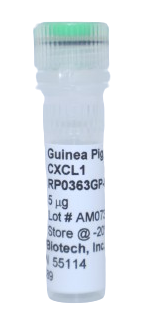
Guinea Pig CXCL1 (GRO alpha) Recombinant Protein
- Catalog Number:
- RP0363GP
- Availability:
- In stock
- Application:
- Cell Culture, Control, ELISA, ELISpot Control, Western Blot Control
- 100% Homology:
- Cavia porcellus (Domestic guinea pig) [Pro53/54Deletion]
 Powered by Bioz
 - Guinea Pig CXCL1 (catalog RP0363GP) is a yeast-derived chemokine supplied lyophilized without carrier protein in 10% trehalose; it has no affinity tags and is naturally endotoxin-free, and should be reconstituted in sterile PBS that contains at least 0.1% carrier protein. The protein is ~7.8 kDa, 72 amino acids long (full sequence provided, note: material contains a Pro53/54 deletion), and >98% pure by SDS-PAGE, with 100% amino-acid homology to domestic guinea pig (with the noted deletion). Store at -20°C (stable up to twelve months from date of receipt; working aliquots with carrier protein stable ~3 months) and avoid repeated freeze/thaw cycles. Product origin is the USA. It is commonly used to study chemokine signaling and neutrophil/ leukocyte chemoattraction and migration; typical experimental uses include chemotaxis and cell-migration assays, cell-culture stimulation and dosing studies, receptor-binding and signaling assays, ELISA and neutralization assays, flow-cytometry and Western blot controls, and antibody generation/validation. Kingfisher Biotech products are supplied for research applications and are not intended for medicinal, diagnostic, or therapeutic use.
| Amino Acid Sequence | APAASELRCR CLRPVRGLHP KNIQSVAVTA PGPHCHQTEV LATLKDGREA CLDEAPMVQK VLQRMLKGSK AT (72) |
| Endotoxin | Naturally endotoxin-free |
| Form | Lyophilized |
| Storage Conditions | -20°C |
| Molecular Weight | 7.8 kDa |
| Purity | >98% as visualized by SDS-PAGE analysis. |
| Expression System | Yeast |
| Form | Lyophilized |
| Country Of Origin | USA |
Guinea Pig CXCL1 (C-X-C motif chemokine ligand 1, also known as GRO-α – growth-regulated oncogene alpha) is a proinflammatory chemokine belonging to the CXC chemokine family, which includes related chemokines such as CXCL2, CXCL3, and CXCL8 (IL-8) that regulate neutrophil recruitment during inflammatory responses. In guinea pigs (Cavia porcellus), CXCL1 is produced by macrophages, epithelial cells, endothelial cells, and fibroblasts in response to infection, inflammatory cytokines, or tissue injury. CXCL1 primarily signals through the chemokine receptor CXCR2, promoting chemotaxis, activation, and migration of neutrophils and other innate immune cells to sites of infection or inflammation. In guinea pig health and research, CXCL1 plays an important role in innate immune defense, particularly in the respiratory tract, where neutrophil recruitment is critical for controlling pathogens. Guinea pigs are widely used as animal models for infectious diseases, especially tuberculosis caused by Mycobacterium tuberculosis and other respiratory infections, where CXCL1-mediated neutrophil recruitment contributes to granuloma formation and inflammatory responses in infected tissues. As a result, guinea pig CXCL1 is studied in immunology, host–pathogen interaction research, and vaccine development, helping to clarify mechanisms of neutrophil-driven inflammation and immune responses in respiratory disease models.
Citations
Please choose a size to see price
RELATED MEDIA
