Slide 1 of 1 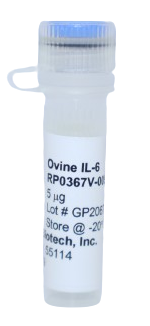
Ovine IL-6 Recombinant Protein
- Catalog Number:
- RP0367V
- Availability:
- In stock
- Application:
- Cell Culture, Control, ELISA, ELISpot Control, Western Blot Control
- 100% Homology:
- Ovis aries (sheep)
 Powered by Bioz
 - Ovine IL-6 (catalog RP0367V) is a yeast-derived cytokine supplied lyophilized without carrier protein in 10% trehalose; it has no affinity tags and is naturally endotoxin-free, and should be reconstituted in sterile PBS that contains at least 0.1% carrier protein. The protein is ~20.4 kDa, 179 amino acids long (full sequence provided), and >98% pure by SDS-PAGE, with 100% amino-acid homology to sheep. Store at -20°C (stable up to twelve months from date of receipt; working aliquots with carrier protein stable ~3 months) and avoid repeated freeze/thaw cycles. Product origin is the USA. It is commonly used to study IL-6 signaling, acute-phase and inflammatory responses, and B-cell differentiation; typical experimental uses include cell-culture stimulation and dosing studies, proliferation/differentiation assays, ELISA and neutralization assays, flow-cytometry and Western blot controls, and antibody generation/validation. Kingfisher Biotech products are supplied for research applications and are not intended for medicinal, diagnostic, or therapeutic use.
| Amino Acid Sequence | GPLGEDFKND TTPSRLLLTT PEKTEALIKH IVDKISAIRK EICEKNDECE NSKETLAENK LKLPKMEEKD GCFQSGFNQA ICLIKTTAGL LEYQIYLDFL QNEFEGNQET VMELQSSIRT LIQILKEKIA GLITTPATHT DMLEKMQSSN EWVKNAKVII ILRSLENFLQ FSLRAIRMK (179) |
| Endotoxin | Naturally endotoxin-free |
| Form | Lyophilized |
| Storage Conditions | -20°C |
| Molecular Weight | 20.4 kDa |
| Purity | >98% as visualized by SDS-PAGE analysis. |
| Expression System | Yeast |
| Form | Lyophilized |
| Country Of Origin | USA |
Ovine Interleukin-6 (IL-6) is a multifunctional pro-inflammatory cytokine and a central member of the IL-6 cytokine family—including IL-6, IL-11, IL-27, IL-31, leukemia inhibitory factor (LIF), oncostatin M (OSM), ciliary neurotrophic factor (CNTF), cardiotrophin-1 (CT-1), and cardiotrophin-like cytokine factor 1 (CLCF1)—which signal through receptor complexes containing the shared gp130 subunit to activate JAK/STAT and MAPK pathways. In sheep (Ovis aries), IL-6 plays a critical role in regulating acute-phase protein production (such as haptoglobin and serum amyloid A), leukocyte recruitment, B- and T-cell differentiation, fever induction, and systemic inflammatory responses during infection, tissue injury, and metabolic stress. Elevated IL-6 expression is associated with economically significant ovine diseases including mastitis, pneumonia, foot rot, caseous lymphadenitis, parasitic infestations, and viral infections such as ovine progressive pneumonia (maedi-visna), where it contributes to inflammation and disease severity. IL-6 also plays an important role in reproductive physiology and periparturient immune modulation. As a biomarker of immune activation, ovine IL-6 is valuable for herd health monitoring, vaccine evaluation, and assessment of inflammatory status. In veterinary and translational research, characterization of ovine IL-6 and related family members supports studies of host-pathogen interactions, small ruminant immunology, reproductive immunology, and development of immune-based strategies to improve animal health, productivity, and welfare.
Citations
Please choose a size to see price
RELATED MEDIA
