Slide 1 of 1 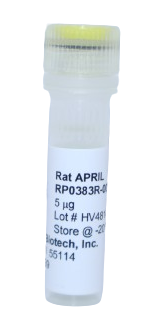
Rat APRIL Recombinant Protein
- Catalog Number:
- RP0383R
- Availability:
- In stock
- Application:
- Cell Culture, Control, ELISA, ELISpot Control, Western Blot Control
- 100% Homology:
- Rattus norvegicus (Norway rat)
 Powered by Bioz
 - Rat APRIL (catalog RP0383R) is a yeast-derived cytokine supplied lyophilized without carrier protein in 10% trehalose; it has no affinity tags and is naturally endotoxin-free, and should be reconstituted in sterile PBS that contains at least 0.1% carrier protein. The protein is ~16.4 kDa, 146 amino acids long (full sequence provided), and >98% pure by SDS-PAGE, with amino-acid homology to rat (Rattus norvegicus). Store at -20°C (stable up to twelve months from date of receipt; working aliquots with carrier protein stable ~3 months) and avoid repeated freeze/thaw cycles. Product origin is the USA. It is commonly used to study APRIL/TACI/BCMA signaling, B-cell survival, plasma-cell differentiation and antibody biology; typical experimental uses include cell-culture stimulation and dosing studies, B-cell proliferation and differentiation assays, receptor-binding and signaling studies, ELISA and neutralization assays, flow-cytometry and Western blot controls, and antibody generation/validation. Kingfisher Biotech products are supplied for research applications and are not intended for medicinal, diagnostic, or therapeutic use.
| Amino Acid Sequence | AVLTQKHKKK QSVLHLVPIN ITSKADSDMT EVMWQPALRR GRGLEAQGDT VRVRDTGIYL LYSQVLFHDV TFTMGQVVSR EGQGRRETLF RCIKSMPSDP DRAYNSCYSA GVFHLHQGDI ITVKIPRANA KLSLSPHGTF LGFVKL (146) |
| Endotoxin | Naturally endotoxin-free |
| Form | Lyophilized |
| Storage Conditions | -20°C |
| Molecular Weight | 16.4 kDa |
| Purity | >98% as visualized by SDS-PAGE analysis. |
| Expression System | Yeast |
| Form | Lyophilized |
| Country Of Origin | USA |
Rat APRIL (A Proliferation-Inducing Ligand), also known as TNFSF13, is a member of the tumor necrosis factor (TNF) superfamily that plays an important role in B cell survival, plasma cell maintenance, and regulation of humoral immunity in rats (Rattus norvegicus). APRIL is produced primarily by monocytes, macrophages, dendritic cells, and certain epithelial and stromal cells, and it signals through the receptors TACI (TNFRSF13B) and BCMA (TNFRSF17) to promote B cell maturation, immunoglobulin class switching, and long-lived plasma cell persistence. In rats, APRIL contributes to mucosal immunity, IgA production, and maintenance of antibody-secreting cells within lymphoid tissues and bone marrow. Dysregulated APRIL expression has been implicated in autoimmune and inflammatory disease models, including experimental arthritis, lupus-like disease, and transplant rejection studies. In biomedical research, rat APRIL is of particular interest in models of antibody-mediated autoimmunity, chronic inflammation, and B cell–related malignancies, where modulation of APRIL signaling is investigated as a strategy to regulate pathological B cell activation and antibody production.
Citations
Please choose a size to see price
RELATED MEDIA
