Slide 1 of 1 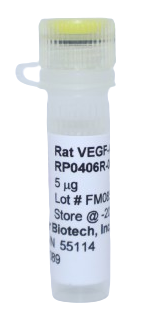
Rat VEGF-A Recombinant Protein
- Catalog Number:
- RP0406R
- Availability:
- In stock
- Application:
- Cell Culture, Control, ELISA, ELISpot Control, Western Blot Control
- 100% Homology:
- Rattus norvegicus (Norway rat)
 Powered by Bioz
 - Rat VEGF-A (catalog RP0406R) is a yeast-derived growth factor supplied lyophilized without carrier protein in 10% trehalose; it has no affinity tags and is naturally endotoxin-free, and should be reconstituted in sterile PBS that contains at least 0.1% carrier protein. The protein is ~20.6 kDa, 188 amino acids long (full sequence provided), and >98% pure by SDS-PAGE, with 100% amino-acid homology to Norway rat. Store at -20°C (stable up to twelve months from date of receipt; working aliquots with carrier protein stable ~3 months) and avoid repeated freeze/thaw cycles. Product origin is the USA. It is commonly used to study angiogenesis, endothelial-cell proliferation, migration, vascular permeability and VEGF-receptor signaling; typical experimental uses include endothelial cell culture stimulation and proliferation/tube-formation assays, receptor-binding and signaling studies, ELISA and neutralization assays, flow-cytometry and Western blot controls, and antibody generation/validation. Kingfisher Biotech products are supplied for research applications and are not intended for medicinal, diagnostic, or therapeutic use.
| Amino Acid Sequence | APTTEGEQKA HEVVKFMDVY QRSYCRPIET LVDIFQEYPD EIEYIFKPSC VPLMRCAGCC NDEALECVPT SESNVTMQIM RIKPHQSQHI GEMSFLQHSR CECRPKKDRT KPEKKSVRGK GKGQKRKRKK SRFKSWSVHC EPCSERRKHL FVQDPQTCKC SCKNTDSRCK ARQLELNERT CRCDKPRR (188) |
| Endotoxin | Naturally endotoxin-free |
| Form | Lyophilized |
| Storage Conditions | -20°C |
| Molecular Weight | 20.6 kDa |
| Purity | >98% as visualized by SDS-PAGE analysis. |
| Expression System | Yeast |
| Form | Lyophilized |
| Country Of Origin | USA |
Rat Vascular Endothelial Growth Factor A (VEGF-A) is a member of the vascular endothelial growth factor (VEGF) family, which includes VEGF-A, VEGF-B, VEGF-C, VEGF-D, and placental growth factor (PlGF)—key regulators of angiogenesis, vascular permeability, and endothelial cell growth. In rats (Rattus norvegicus), VEGF-A is produced by a wide variety of cells including endothelial cells, macrophages, fibroblasts, epithelial cells, smooth muscle cells, and tumor cells, particularly in response to hypoxia, inflammation, and tissue injury. VEGF-A exerts its biological effects primarily through binding to VEGF receptor-1 (VEGFR-1/Flt-1) and VEGF receptor-2 (VEGFR-2/KDR) on endothelial cells, activating intracellular signaling pathways such as MAPK/ERK, PI3K/AKT, and PLCγ, which promote endothelial cell proliferation, migration, vascular permeability, and new blood vessel formation. In rats, VEGF-A plays essential roles in embryonic vascular development, wound healing, tissue regeneration, and organ repair following injury or ischemia. Rat VEGF-A has been widely studied in experimental models of cardiovascular disease, ischemia, cancer, diabetic complications, and retinal disorders, where VEGF-mediated angiogenesis contributes to both tissue repair and pathological vascular growth. Because rats are commonly used in vascular biology, pharmacology, and disease modeling, characterization of rat VEGF-A has provided important insights into angiogenic signaling and therapeutic strategies targeting VEGF pathways.
Citations
Please choose a size to see price
RELATED MEDIA
