Slide 1 of 1 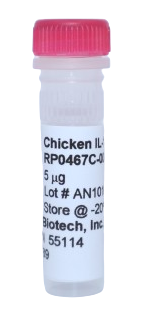
Chicken Receptor Antagonist (IL-1RA) Recombinant Protein
- Catalog Number:
- RP0467C
- Availability:
- In stock
- Application:
- Cell Culture, Control, ELISA, ELISpot Control, Western Blot Control
- 100% Homology:
- Gallus gallus (chicken)
 Powered by Bioz
 - Chicken IL-1 receptor antagonist (catalog RP0467C) is a yeast-derived cytokine supplied lyophilized without carrier protein in 10% trehalose; it has no affinity tags and is naturally endotoxin-free, and should be reconstituted in sterile PBS that contains at least 0.1% carrier protein. The protein is ~17.8 kDa, 157 amino acids long (full sequence provided), and >98% pure by SDS-PAGE, with 100% amino-acid homology to chicken. Store at -20°C (stable up to twelve months from date of receipt; working aliquots with carrier protein stable ~3 months) and avoid repeated freeze/thaw cycles. Product origin is the USA. It is commonly used to study IL-1 signaling and inflammatory regulation (including inhibition of IL-1-mediated responses); typical experimental uses include cell-culture stimulation and inhibition studies, cytokine signaling assays, ELISA and neutralization assays, flow-cytometry and Western blot controls, and antibody generation/validation. Kingfisher Biotech products are supplied for research applications and are not intended for medicinal, diagnostic, or therapeutic use.
| Amino Acid Sequence | SVPCRAPALQ TKVFKYRIWD MNQQSLYLRD DQLVAGHLQG ANAALEEKVF WVPNRFFKHE LQPVIMGIRN GTRCLACPAA PQPTLQLQDA DITELPRSGA ASAPFTFFRT YKDGLWRFES AANPGWFLCT SARAHQPLGL SRRPDAAHVL DFYFQLC (157) |
| Endotoxin | Naturally endotoxin-free |
| Form | Lyophilized |
| Storage Conditions | -20°C |
| Molecular Weight | 17.8 kDa |
| Purity | >98% as visualized by SDS-PAGE analysis. |
| Expression System | Yeast |
| Form | Lyophilized |
| Country Of Origin | USA |
Chicken Interleukin-1 Receptor Antagonist (IL-1Ra) is an anti-inflammatory cytokine produced by monocytes, macrophages, and other immune cells in chickens (Gallus gallus) that functions as a key regulator of IL-1–mediated inflammation. IL-1Ra competitively binds to the IL-1 receptor (IL-1R1) without initiating downstream signaling, thereby blocking the pro-inflammatory effects of IL-1β and limiting activation of NF-κB and MAPK pathways that drive fever, leukocyte recruitment, and acute-phase responses. In poultry health, IL-1Ra plays an important role in modulating inflammatory responses during infections such as avian influenza virus, Newcastle disease virus, infectious bronchitis virus, Salmonella spp., and Eimeria (coccidiosis), helping to balance effective pathogen clearance with prevention of excessive tissue damage in respiratory and intestinal tissues. Dysregulation of IL-1/IL-1Ra balance may influence disease severity, growth performance, and flock welfare. As a marker of anti-inflammatory regulation, chicken IL-1Ra is relevant in vaccine evaluation, immune modulation studies, and genetic selection for improved disease resilience. In avian immunology research, characterization of IL-1Ra supports investigations into cytokine network regulation, resolution of inflammation, and comparative innate immune control mechanisms relevant to both poultry production and broader vertebrate inflammatory biology.
Citations
Please choose a size to see price
RELATED MEDIA
